
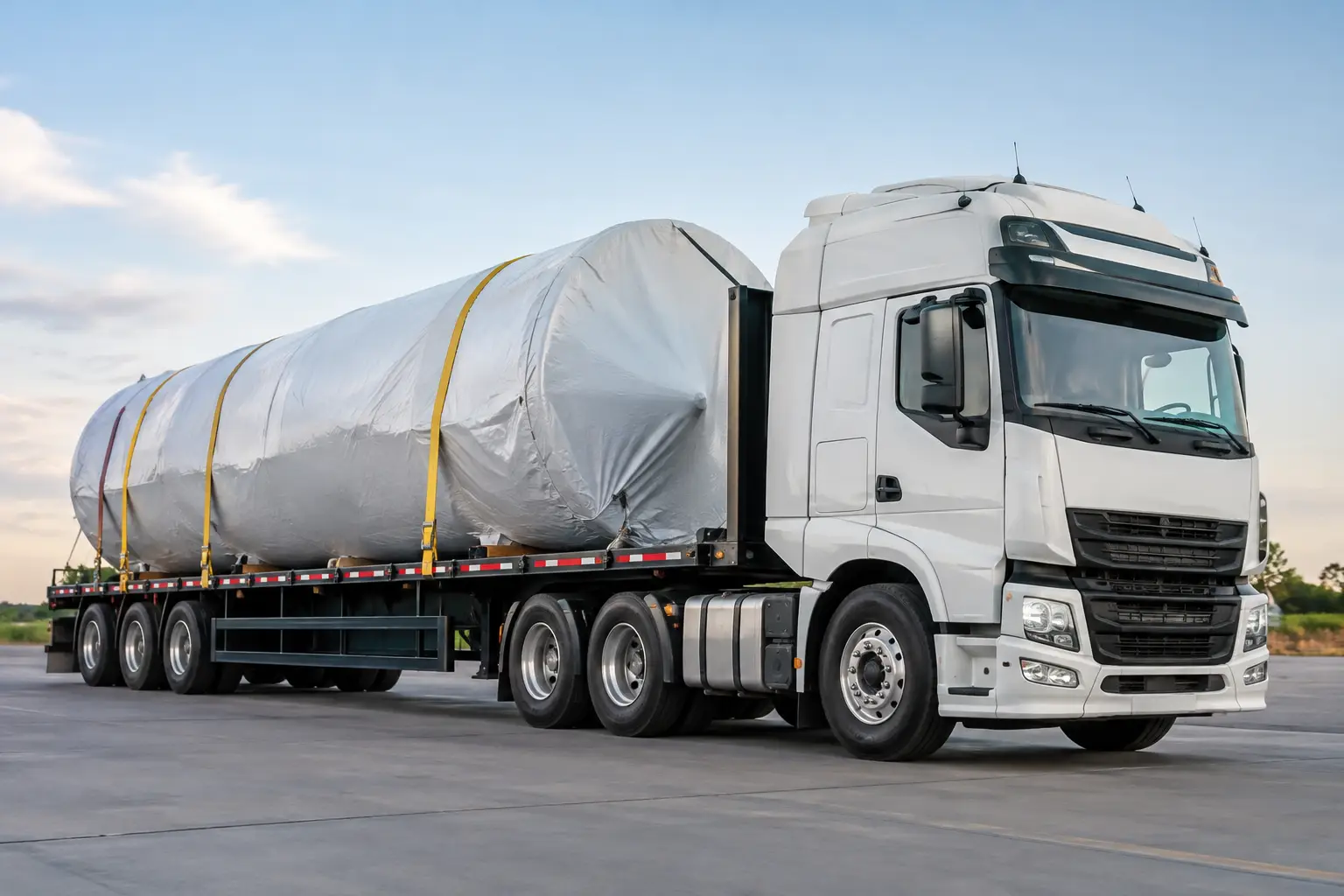
A load can be too long for a standard van, too tall to clear a fixed roof, too fragile for a pallet network, or simply impossible to handle through multiple depots. When customers ask what vehicles carry awkward freight, the useful answer is not a single vehicle type. It is the vehicle that matches the freight’s size, weight, shape, loading method, delivery deadline and handling risk.
For an urgent machine guard, exhibition stand, shop-fitting component or valuable framed item, choosing the wrong vehicle can mean damage, delay or a failed collection. Dedicated transport avoids that gamble. One suitable vehicle collects the consignment, carries it directly to its destination and stays under the control of a trained driver from collection to proof of delivery.
What vehicles carry awkward freight?
Awkward freight is not always exceptionally heavy. A lightweight item can still need specialist transport if it is oversized, top-heavy, delicate, long, difficult to secure or unsuitable for fork-lift loading. The right choice starts with an honest assessment of the consignment rather than an assumption that it will fit in the next available van.
A small van is often the right answer for compact but urgent goods. Legal documents, sensitive prototypes, boxed electronics, small artwork and critical replacement parts can travel securely without paying for unused capacity. It is also a practical option for tight city-centre collections and deliveries where access is restricted. The limitation is obvious: long, wide or palletised freight quickly exceeds its safe loading space.
For larger items, medium and large vans provide more usable length and height while retaining the flexibility to reach many commercial premises. They suit multiple cartons, bulky retail displays, long joinery pieces, print materials, equipment cases and light pallets. A van may be ideal where a lorry would struggle with access, but payload must still be checked carefully. Volume and weight are different constraints, and both matter.
When freight becomes genuinely oversized, heavy or operationally complex, a lorry is often the safer option. A 7.5-tonne, 18-tonne or 26-tonne vehicle can carry substantial loads, larger quantities and materials that cannot be safely accommodated in a van. This is particularly relevant for construction supplies, manufacturing components, machinery, shop fittings and staged event equipment.
Curtainsiders and sliding-roof vehicles
Some consignments are awkward because they cannot be loaded through rear doors. Long steelwork, large crates, machinery assemblies and tall structures may need side loading or loading from above. A curtainsider gives broad side access, which can make loading safer and more efficient where a forklift is available.
A sliding-roof lorry adds another important option. The roof can be moved aside so freight can be lifted in by crane or overhead lifting equipment. This is useful on construction sites, industrial premises and locations handling loads that are too tall, too long or too difficult to manoeuvre through conventional doors. It also reduces the temptation to force an unsuitable load into a vehicle, which is where avoidable damage often begins.
Vehicles with mounted forklifts
A suitable vehicle alone does not solve a delivery if the receiving site has no unloading equipment. A mounted forklift allows the driver to unload palletised or heavy goods at locations without a forklift on site. It can be a decisive requirement for building sites, rural premises, trade counters and temporary works.
This option depends on ground conditions and access. Soft ground, narrow entrances, steep gradients and restricted turning space can affect whether a mounted forklift is appropriate. Good transport planning considers the delivery point as closely as the collection point, including whether there is room to unload safely and whether the recipient can accept the goods at the agreed time.
Match the vehicle to the handling plan
Dimensions are the starting point, not the whole decision. Before booking awkward freight, provide the length, width, height and weight of every item, plus whether it is packed, crated, on a pallet or loose. Accurate details allow the transport provider to allocate adequate load space, payload and securing points.
The loading plan matters just as much. A glass partition needs different protection from a steel beam. A high-value display unit may need blankets, straps and careful positioning away from other goods. A long item may require enough internal length to lie flat and be restrained properly, rather than travelling at an angle or with doors under pressure.
Centre of gravity is another concern that is easy to miss. Top-heavy items, machinery with uneven weight distribution and irregularly shaped goods must be loaded in a stable position. Weight should be distributed sensibly across the vehicle, with suitable restraint to prevent movement during braking or cornering. A direct service is particularly valuable here because the load is not repeatedly moved, cross-docked or combined with unrelated consignments.
For fragile freight, the shortest route is not always the only consideration. Road quality, access restrictions, timed arrival slots and weather exposure may affect how the journey should be planned. A trained driver and a dedicated vehicle allow these decisions to be made around the consignment rather than around a multi-drop schedule.
When a standard courier network is not enough
Parcel and pallet networks are designed for high volumes of standardised freight. They work well for many routine deliveries, but awkward goods can fall outside their operating model. A parcel that is oversized, unusually shaped or too valuable to risk through several handling points may face surcharges, delays or rejection.
The issue is not simply whether the freight can physically enter a network. It is whether the handling process is suitable. Multiple scans, cages, depots and vehicle changes create more opportunities for an item to be knocked, misplaced or delayed. That risk becomes commercially serious when a shop-fitting team is waiting on site, a production line needs a replacement part, or an event cannot proceed without a specific item.
Dedicated transport uses one vehicle for one important delivery. The consignment is collected and taken straight to the required UK destination, without depot transfers or multi-drop handling. This provides clearer accountability, more precise timing and the ability to communicate directly about collection, progress and delivery completion.
Questions to answer before choosing a vehicle
The quickest way to arrange the right transport is to share the details that change the vehicle decision. Alongside dimensions and weight, explain the urgency, collection and delivery postcodes, available loading equipment, site restrictions and whether the item is fragile or high value.
It is also worth flagging anything that makes access unusual. Is collection from an upper floor? Does the delivery require a booking slot? Is there a low bridge, limited parking, a gated site or a strict delivery deadline? These details can determine whether a van is practical, whether a lorry needs specialist access, or whether a vehicle with a mounted forklift is required.
Photographs can be particularly helpful for irregular freight. They reveal protruding parts, vulnerable surfaces, lifting points and packaging limitations that a basic description may not capture. That allows a transport consultant to plan suitable protection and loading before the vehicle arrives, rather than trying to improvise at collection.
Direct transport for freight that cannot be treated as routine
A dedicated service is not only for the largest loads. It is often the sensible choice for a single fragile item, an urgent component or a consignment with a fixed delivery time. The value lies in control: appropriate vehicle selection, secure loading, real-time tracking and a driver focused on that delivery alone.
Redhead Couriers operates vehicles from small vans through to 26-tonne lorries, including sliding-roof and mounted-forklift options. That range means the vehicle can be selected around the job, rather than making the job fit a limited fleet. It also supports practical collection planning across Essex, London, Suffolk and the wider UK.
If a consignment is difficult to describe, do not reduce it to “a few boxes” and hope for the best. Share its measurements, photographs and delivery requirements with a dedicated Transport Consultant. The right vehicle and a properly planned direct journey protect more than the freight – they protect the work that depends on it arriving safely and on time.