
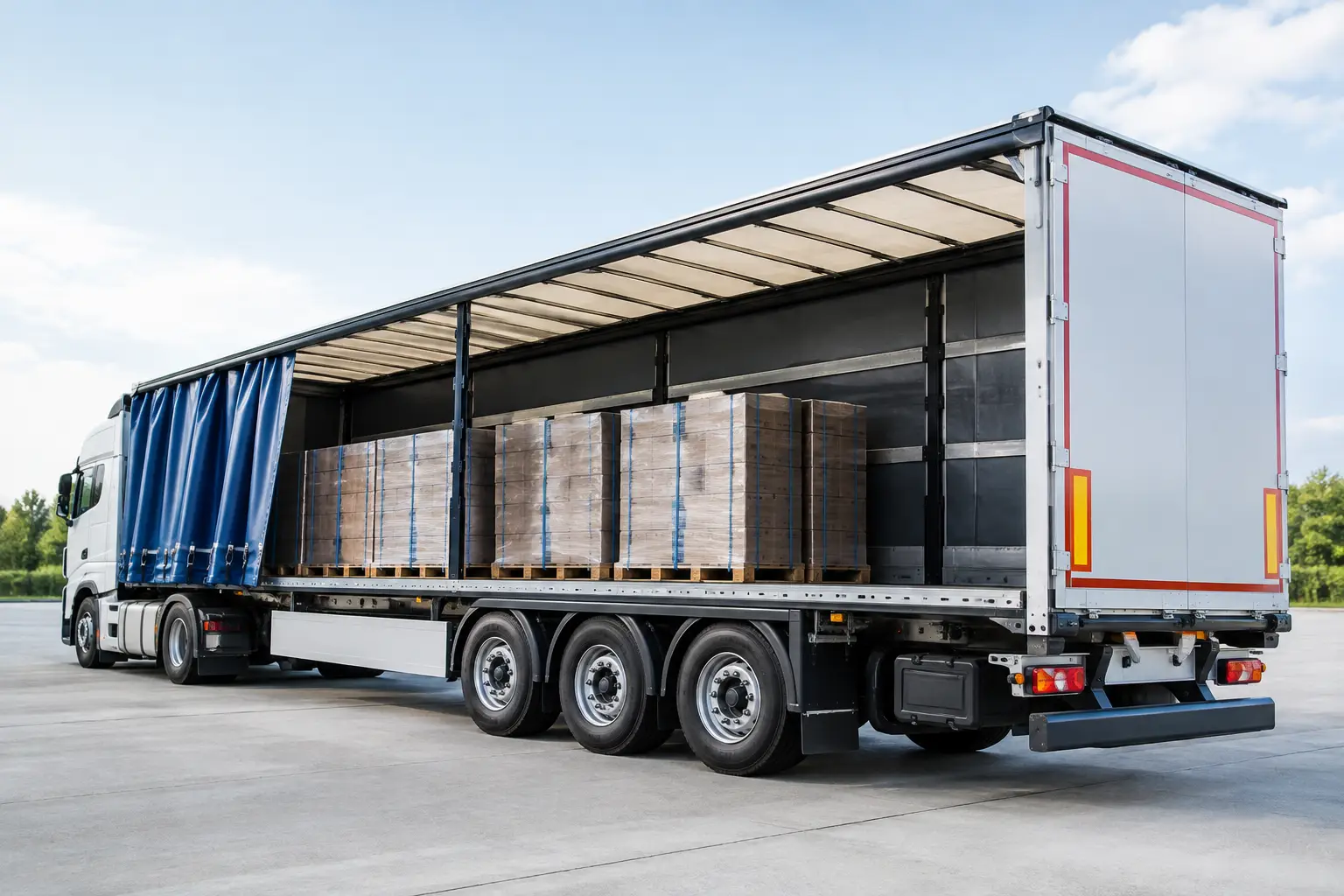
A long steel frame, crated machine or shopfront section can be perfectly packed and still become a delivery problem at the loading point. If it cannot safely pass through rear doors or be lifted in from the side, sliding roof lorry transport provides the practical answer: load from above by crane, then move the consignment directly to site in a protected vehicle.
For time-critical work, the choice of vehicle is not a minor detail. It determines whether a load can be collected safely, whether it arrives in the right condition and whether a fitting team, production line or construction programme is left waiting. The right lorry turns an awkward movement into a controlled delivery.
What is sliding roof lorry transport?
A sliding roof lorry has a movable roof covering that can be drawn back to create overhead access to the load area. This allows goods to be lifted vertically into or out of the vehicle using a crane, gantry or overhead lifting equipment. Once loaded, the roof is closed again to protect the consignment during transport.
It is a specialist option for items that are too long, tall, heavy or impractical to load through conventional rear doors. Unlike an open flatbed, the load travels under cover. Unlike a standard curtain-sided vehicle, access from above is available where a crane is already in place.
That distinction matters. A consignment may be physically capable of travelling on several vehicle types, but only one may allow safe loading at both ends of the journey. Matching the lorry to the collection and delivery conditions avoids last-minute handling improvisation.
When a sliding roof lorry is the right choice
The most common reason to book a sliding roof vehicle is crane loading. Construction suppliers may need to move steelwork, glazing frames, cladding materials or fabricated sections directly to a site. Manufacturers may have machinery components, oversized assemblies or specialist equipment that needs lifting vertically. Shop fitters and exhibition teams may have bulky sections that are difficult to manoeuvre through a rear aperture.
Length is often as significant as weight. An item can be relatively light but too long to turn safely into a lorry through standard doors. Loading it from above can remove that restriction and reduce the risk of damage to the item, vehicle or people handling it.
Sliding roof lorry transport is also useful where access is tight. A busy construction site may have a tower crane or mobile crane available, but limited room for forklifts to manoeuvre alongside the vehicle. In those circumstances, an overhead lift can be the most efficient and controlled method.
It is not automatically the best solution for every large load. If there is no suitable lifting equipment at collection or delivery, a vehicle with a mounted forklift, tail lift or other loading arrangement may be more appropriate. The key question is not simply, “What size is the item?” It is, “How will it be lifted, secured and unloaded at each location?”
Protected transport without network handling
A sliding roof lorry should not mean exposing a valuable load to unnecessary risk. With a dedicated transport service, the vehicle collects your consignment and takes it directly to its destination. There are no depot transfers, no multi-drop route and no repeated loading between different vehicles.
This is particularly valuable for fragile, high-value or made-to-measure goods. Architectural glazing, bespoke joinery, printed displays and precision equipment can all be affected by poor handling, rushed transfers or avoidable movement in transit. Direct transport gives the driver and transport team clear responsibility from collection through to delivery.
For a site delivery, it also gives you a more reliable arrival plan. Rather than waiting within the broad time window of a pallet network, you can arrange a timed collection and delivery that works around crane slots, labour availability, road restrictions and installation schedules. Your consignment is tracked, the driver remains accountable and proof of delivery is available once the job is complete.
Planning the load properly
Specialist transport is won before the lorry arrives. A few accurate details allow the right vehicle, loading method and delivery plan to be arranged from the start.
Dimensions, weight and lifting points
Provide the length, width, height and confirmed weight of every item, including packaging, stillages or timber bearers. Photographs are helpful where a load has an unusual shape. If the item must be lifted with slings, chains or a spreader beam, the collection and delivery teams need to know the approved lifting points and any manufacturer instructions.
Weight distribution matters too. A long fabricated item may be light overall but require specific support positions to prevent bending or distortion. The lorry loading plan should reflect how the item needs to sit in transit, not just where there is empty floor space.
Collection and delivery access
A crane does not remove every access issue. Confirm whether the vehicle can enter the site, where it can park during loading and whether there are low bridges, overhead cables, narrow gates, weight limits or booking requirements. At delivery, establish who is responsible for unloading and whether the lifting equipment will be ready at the agreed time.
The driver must not be placed under pressure to make an unsafe lift because a crane booking is running late or a site has not been prepared. Clear communication before collection protects the schedule and everyone involved.
Securing the consignment
Once the roof is closed, the load needs to be restrained appropriately for the journey. This may involve rated straps, edge protection, timber packing, anti-slip materials or purpose-made supports. The correct method depends on the load, its finish and the distance travelled.
A painted aluminium frame, for example, should not be secured in the same way as a structural steel section. The aim is not merely to stop movement. It is to keep the item 100% safe from rubbing, pressure damage and avoidable vibration while the lorry is on the road.
Common uses across UK projects
Sliding roof transport is often associated with construction, but its applications are wider. It can support manufacturers sending machinery assemblies to a customer, printers moving oversized display structures, and facilities teams replacing plant equipment where rooftop or overhead lifting is required.
It is particularly effective for scheduled project work where delivery time is as important as the item itself. A delayed frame can hold up glazing. A missing fabricated component can stop a fitting crew. A late machine part can leave production capacity idle. In these cases, the cost of the wrong transport arrangement is usually greater than the cost of specifying the right one from the outset.
For urgent movements, the same principle applies. A dedicated lorry can collect promptly and travel straight to the destination, with no need to wait for a consolidated route to fill. That is a very different service from sending an item into a general freight network and hoping it reaches the right depot at the right time.
Why driver experience matters
The roof mechanism is only one part of the service. The driver needs to understand site safety, load restraint, delivery procedures and the importance of communicating clearly with site contacts. They also need to recognise when conditions are not safe for loading or unloading.
A good specialist driver will arrive prepared, check the load arrangement, work professionally with the lifting team and keep you informed if circumstances change. This is especially valuable when the person arranging transport is not present at the collection or delivery point.
At Redhead Couriers, specialist vehicles are operated as part of a dedicated, one-vehicle, one-delivery service. That means a trained driver, controlled handling and a direct route planned around your consignment rather than a generic multi-drop schedule.
Get the vehicle decision right before collection
If your load needs overhead access, a sliding roof lorry can remove a major obstacle while keeping the journey protected and controlled. But the best result depends on the full plan: accurate dimensions, safe lifting arrangements, site access and a delivery time that gives the receiving team what it needs.
Before booking, speak to a transport consultant with the details of the item and both locations. A short conversation at the planning stage can prevent a failed collection, a missed crane slot or a damaged consignment later. When the delivery matters, the lorry should fit the job from the first lift to final proof of delivery.