
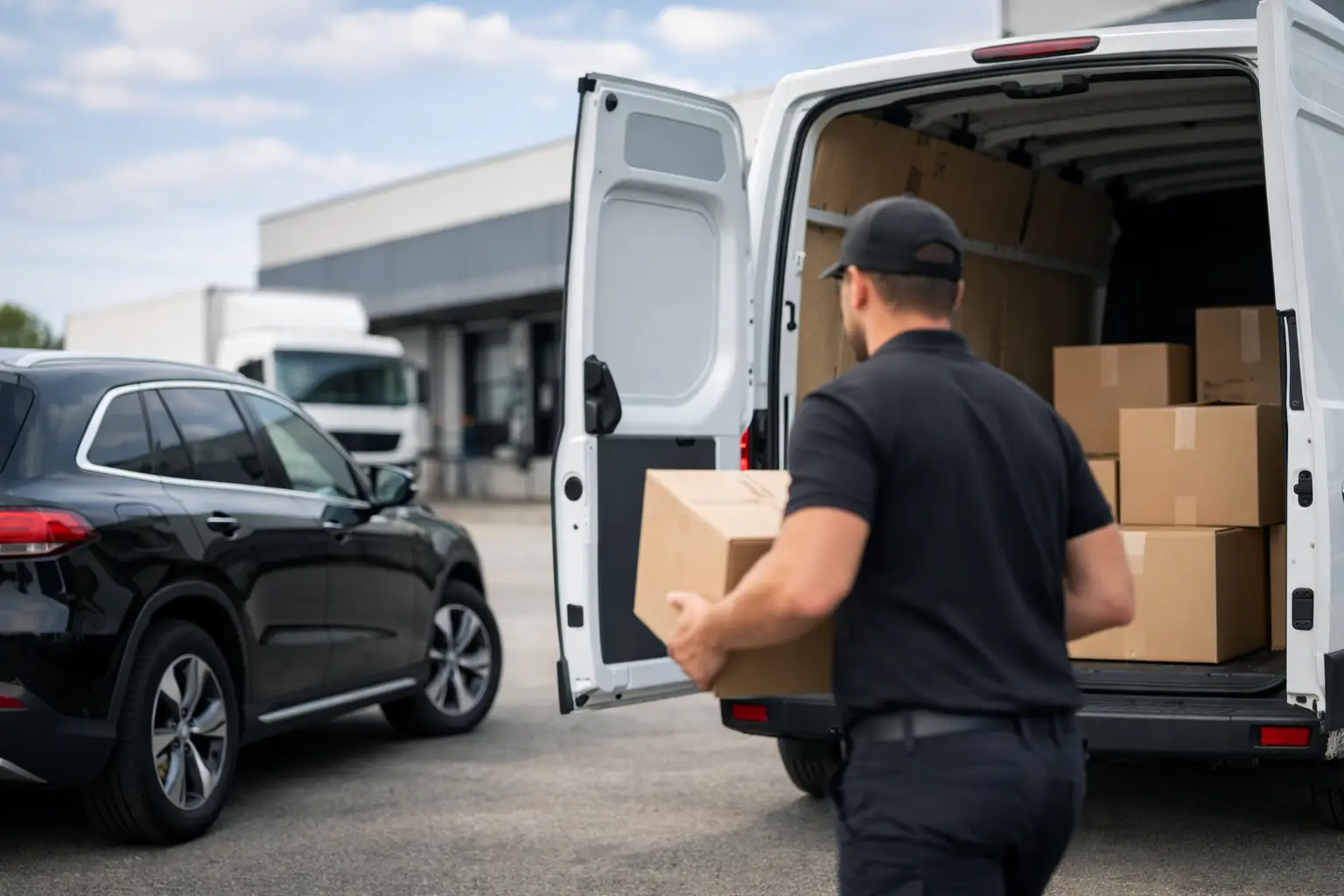
A production line is waiting for one missing component. A shop fitting team has a fixed overnight installation slot. A legal department needs original documents delivered before a deadline. In these situations, the question is not simply whether a courier can collect. It is: what is dedicated vehicle delivery, and will it keep this consignment under control from collection to handover?
Dedicated delivery gives one consignment its own vehicle and its own direct journey. The driver collects from you, travels to the named destination, and delivers without routing your item through depots, sorting hubs or a sequence of unrelated drops. It is a practical service for deliveries where delay, damage or uncertainty would create a real problem.
What is dedicated vehicle delivery?
Dedicated vehicle delivery is a direct transport service in which a vehicle is assigned specifically to your consignment. It does not share its route with a parcel network or multi-drop schedule. Once collected, your item stays on board until it reaches the delivery point.
This is often called a one-vehicle, one-delivery service. The principle is straightforward, but the difference it makes can be substantial. Fewer handling points mean fewer opportunities for damage, misrouting and delay. A direct route gives clearer control over timing. A named driver and live updates provide accountability when a delivery matters.
The vehicle is chosen around the job, rather than forcing the job into a standard parcel format. That may mean a small van for urgent documents or boxed equipment, a long-wheelbase van for exhibition materials, or a 26-tonne lorry for machinery, construction supplies or shop fittings. Where access and loading demand it, specialist equipment such as a sliding roof or mounted forklift can be arranged.
Dedicated transport is available for same-day work, timed collections, scheduled deliveries and urgent out-of-hours requirements. The right option depends on the consignment, the route, site restrictions and the deadline at the other end.
How dedicated delivery differs from a standard courier network
A standard parcel network is designed for volume. Parcels are collected with many others, moved through one or more depots, sorted, loaded onto different vehicles and delivered on a planned local route. It is an efficient model for routine, packaged goods where next-day timing is acceptable and an item can tolerate repeated handling.
That model is not automatically wrong. For a small, non-urgent parcel, it may be the sensible and lower-cost choice. The issue comes when the item is fragile, high-value, oversized, unusually shaped or needed at a precise time. Each transfer creates another handling event, another scan and another point at which the delivery can be delayed or sent in the wrong direction.
With a dedicated vehicle, there are no consolidation depots and no unrelated deliveries taking priority en route. Your consignment is loaded, secured and driven directly to its destination. The collection and delivery details can be agreed in advance, including access instructions, a named contact, booking-in requirements and proof of delivery.
For operational teams, this changes the conversation from “Has it entered the network?” to “Where is the vehicle, and when will it arrive?” Real-time tracking and direct communication make that answer far easier to provide.
When is a dedicated vehicle the right choice?
Dedicated delivery is usually chosen when the cost of failure is greater than the cost of direct transport. That failure might be a lost working day, a stopped production process, a missed installation, a contract penalty or damage to an irreplaceable item.
Construction and manufacturing businesses often use it for parts that are needed to keep work moving. A replacement component may be relatively small, but if engineers are waiting on site, speed and certainty matter more than sending it through a next-day network.
Advertising, print and publishing teams may need proofs, display materials, campaign stock or event graphics delivered in a particular condition and at a fixed time. A bent board, wet box or late arrival can undermine weeks of preparation. A direct vehicle allows the load to be secured appropriately and delivered to the person expecting it.
Shop fitting and retail teams frequently work to tight site windows. Deliveries may need to arrive before a centre opens, after trading hours or while a fitting crew is on site. A timed dedicated service provides a more dependable plan than waiting for a broad all-day delivery slot.
Legal firms and private customers may use the service for original files, artwork, antiques, specialist equipment or other items that should not pass through several hands. The value is not always just financial. Some consignments are difficult or impossible to replace.
Control starts before the vehicle arrives
Direct delivery works best when the transport provider asks the right questions at the start. Dimensions and weight are only part of the picture. The collection point may have limited loading space. The destination may require a booking reference, a tail lift, a forklift, a driver induction or delivery by a particular time. A large item may need protecting from movement, moisture or pressure from other freight.
A capable provider will match the vehicle to the load and route, then plan the collection around the practical realities of both sites. That avoids the familiar problems of a van arriving too small, a lorry unable to access the location, or a delivery being refused because the receiving team was not expecting it.
For awkward or heavy loads, speak about the loading method early. A mounted forklift can be useful where there is no unloading equipment at the destination. A sliding-roof vehicle can support crane loading. These are not extras to decide on after collection has been booked. They can determine whether the job is completed safely and on time.
Careful loading is equally important. The aim is not merely to fit the consignment inside the vehicle. It must be restrained, protected and positioned so it arrives in the same condition in which it was collected. Trained drivers and clear handling instructions are central to that standard.
What happens from booking to proof of delivery?
The process should feel controlled rather than complicated. You provide the collection and delivery details, the nature of the item, its size, weight, urgency and any handling requirements. A transport consultant can then advise on the right vehicle, collection time and service level.
Once confirmed, the vehicle is allocated to your job. The driver collects the consignment, checks the relevant details and secures the load. The route is then direct to the delivery address, with tracking available so you can monitor progress and update your own customer or site team.
At the destination, the driver delivers to the agreed contact and obtains proof of completion. If there is a delivery problem, such as a closed site, access restriction or missing contact, the benefit of dedicated transport is that the issue can be dealt with directly. Your item is not left circulating around a network with limited visibility.
This does not mean every journey is free from road delays. Traffic, road closures and site conditions can affect any UK delivery. The difference is that a dedicated service gives the provider more control over the response: route changes can be considered, delivery contacts can be updated and the vehicle remains focused on your consignment.
Cost, speed and the trade-off to consider
A dedicated vehicle normally costs more than sending a standard parcel because you are paying for exclusive use of the vehicle, driver time and a direct route. It is not intended to replace routine parcel distribution.
However, comparing only the delivery price can be misleading. Consider the cost of an engineer waiting, an installation crew standing down, a launch being postponed or a high-value item being damaged in transit. For those jobs, dedicated transport is often the more economical decision because it reduces avoidable risk.
The distance, vehicle size, collection urgency, delivery deadline and specialist requirements will all affect the quote. A planned scheduled delivery may offer more flexibility than an immediate collection, while an urgent same-day job may require the nearest suitable vehicle to be dispatched straight away. Clear information at the booking stage helps secure the right service without paying for capability you do not need.
Choosing a provider you can rely on
Look beyond a promise of fast delivery. Ask whether the provider owns and operates suitable vehicles, whether drivers are trained in secure handling, and how you will receive tracking and proof of delivery. Check that it can manage the load you actually have, not just standard boxes and pallets.
For businesses with regular requirements, an account arrangement can also bring consistency. Your usual collection sites, delivery preferences and service expectations can be understood over time, making urgent bookings quicker to arrange. Redhead Couriers supports this kind of direct, accountable transport across Essex, Suffolk, London and the wider UK.
If a consignment cannot afford an unnecessary handover, a missed time slot or a vague delivery update, treat transport planning as part of protecting the job itself. The right dedicated vehicle, properly matched and directly managed, gives your delivery the attention it deserves.