
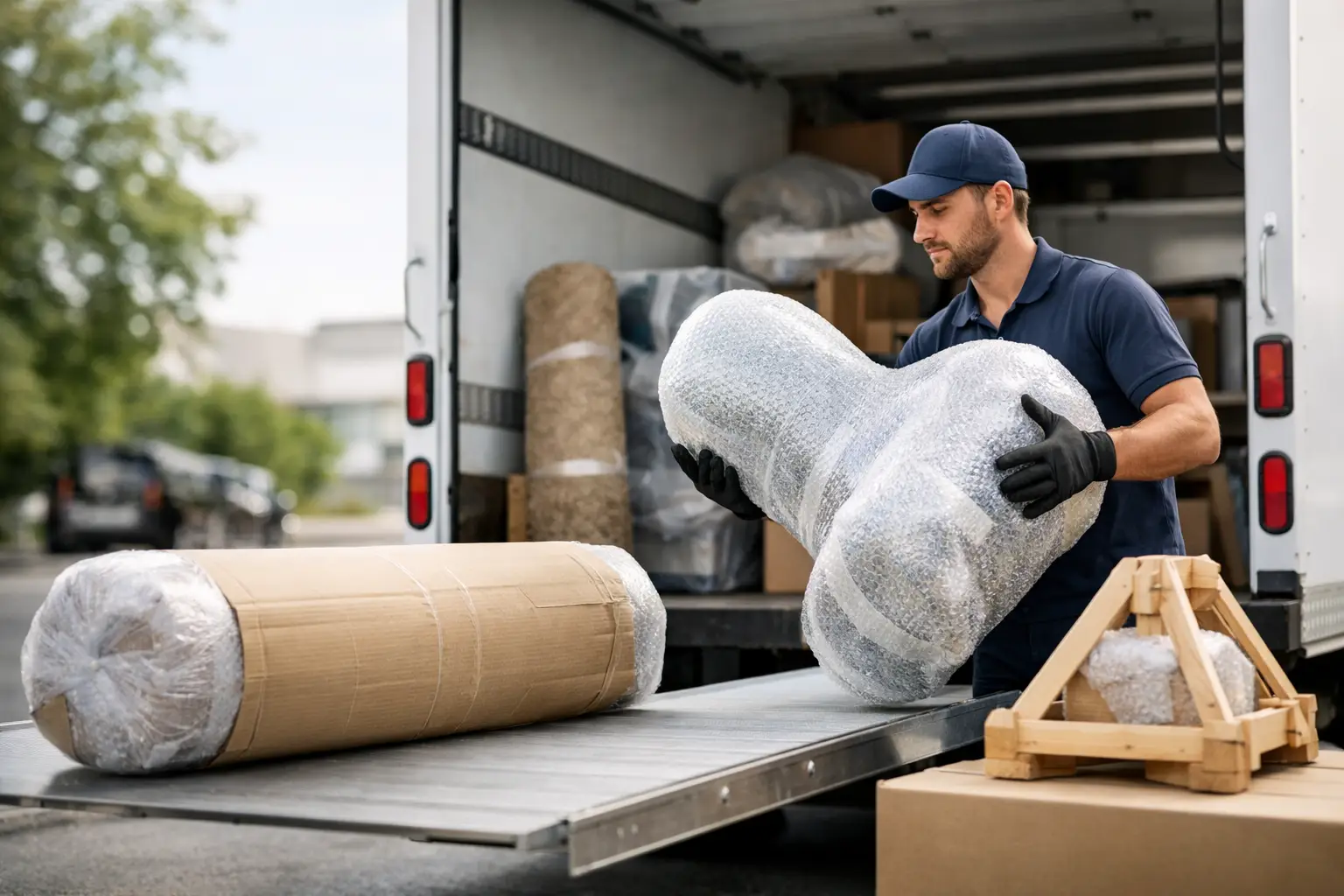
A curved display stand, a full-height glass panel, a fabricated steel frame or a crated machine part can be perfectly ready to leave your premises and still be impossible to send safely through a standard network. Unusually shaped item delivery is not simply about finding a van with enough room. It is about controlling how an item is lifted, secured, transported and handed over, so it arrives in the condition and at the time your operation requires.
For businesses working to installation dates, production schedules, client launches or site deadlines, an awkward item is often the one that cannot be replaced quickly. The right transport plan protects more than the consignment. It protects the people waiting for it, the work booked around it and your reputation.
Why unusual shapes need dedicated transport
Parcel and pallet networks are designed for repeatable, standardised freight. That model works well for boxes, cartons and conventional pallet loads that can tolerate sorting, scanning, depot transfers and several handling points. It becomes a poor fit when an item is long, top-heavy, irregular, fragile or difficult to grip safely.
A shaped item may take up less space than a pallet but need far more thought. A tall architectural model can be vulnerable to vibration. A wrapped shopfitting unit may have protruding corners that cannot be stacked against other freight. An oversized print or exhibition piece may be light, yet easily crushed if another consignment shifts during transit.
Dedicated transport removes those unnecessary risks. One suitable vehicle collects your item, carries only the delivery that matters and travels directly to its destination. There are no depot belts, no cross-docking and no multi-drop route where other collections compete for space or delay the journey. Tracked. Safe. On time.
The shape is only part of the transport decision
Dimensions matter, but they do not tell the whole story. Before arranging collection, a capable courier will consider how the item behaves in transit and what the collection and delivery points can accommodate.
Weight, balance and handling points
A long item with a high centre of gravity needs different restraint from a flat, dense item of the same weight. The question is not only whether it fits in the vehicle, but whether it can remain stable under braking, cornering and normal road movement. Safe loading may require a particular orientation, protective packing, straps, load bars or a vehicle that leaves enough clearance around the item.
Handling points are equally relevant. Can the consignment be lifted from beneath? Does it have a crate, feet or a frame? Is a forklift available at either end? Where machinery or fabricated components are involved, this information prevents rushed decisions at the kerbside.
Access at both ends
Many deliveries fail because the vehicle was selected for the item but not for the site. A narrow Essex lane, a central London loading restriction, a low entrance, a restricted delivery bay or a construction site with limited plant can all change the best approach.
A direct courier service should ask about access before dispatching a vehicle. It may be that a small van is right for a time-critical, delicate item entering a city-centre location. In another case, a larger vehicle with a sliding roof or mounted forklift is the sensible choice for a bulky load going directly to site. The best vehicle is not always the biggest one. It is the one that protects the consignment while allowing a safe, practical delivery.
Time sensitivity and delivery conditions
Some goods are awkward because they must arrive during a narrow window. A retail fit-out may need materials before an overnight installation begins. A replacement manufacturing part may be holding up a production line. A legal, print or advertising job may have a fixed event or publication deadline.
When the timing is critical, a scheduled or same-day dedicated vehicle provides accountability from collection through to proof of delivery. The driver is focused on one job, and you can receive real-time updates rather than trying to work out where an item is within a national network.
What dedicated unusually shaped item delivery looks like
The process should be straightforward for the customer, even when the load is not. Start by providing accurate dimensions, approximate weight, collection and delivery postcodes, photos where available, and any information about fragility, packaging, site access and required arrival time.
That allows a Transport Consultant to match the load to the right vehicle and handling method. Redhead Couriers operates vehicles ranging from small vans to 26-tonne lorries, including specialist options for consignments that need more than standard rear-door access. The aim is not to force an item into a vehicle because it is available. It is to send the vehicle that gives the load the right space, security and route capability.
On collection, trained drivers assess the item and load it with the agreed protection and restraint. The consignment then travels directly to its named destination. This one-vehicle, one-delivery approach is particularly valuable for fragile displays, construction materials, machinery parts, shaped furniture, artwork, signage and bespoke manufactured pieces.
At delivery, the driver completes the agreed handover and proof of delivery is captured. If there are site instructions, a named contact, a timed slot or a specific unloading requirement, these should be confirmed before the journey begins rather than discovered on arrival.
When a standard courier may still be suitable
Not every unusual item needs a specialist vehicle. A lightweight item in a strong, compact crate may travel safely through a conventional service if its dimensions are within limits, its delivery date is flexible and the consequences of a delay are low.
The trade-off is control. Standard networks are built around volume and shared handling, which can be cost-effective for routine work but provides less certainty for an item that cannot be stacked, cannot be reworked or must reach site at a precise time. If damage, delay or failed access would cost more than the delivery itself, dedicated transport is usually the more sensible decision.
It also depends on packaging. Good packaging is essential, but it cannot correct an unsuitable transport method. Protective materials reduce the chance of cosmetic damage; they do not prevent an irregular load from moving if it has not been properly secured, or solve the problem of a vehicle unable to unload safely at destination.
Avoid the common booking mistakes
The most useful information is often the detail that appears minor at first. Do not describe a load as simply “large” or “fragile” when it has a protruding section, a one-sided weight distribution, a polished surface, a required upright position or a lifting restriction. A photograph and a few precise measurements can prevent the wrong vehicle arriving.
Be clear about whether collection staff can assist with loading, whether the receiver has unloading equipment and whether the driver needs to call ahead. For building sites, retail centres and controlled premises, confirm booking references, delivery hours and any PPE or induction requirements. A direct delivery is faster when the route into the building is as well planned as the route on the road.
Finally, do not leave the booking until the item is wrapped and waiting on the floor. Early advice gives more options, particularly where specialist equipment, timed collection or a larger lorry is needed.
A safer answer to an awkward delivery
Unusual freight does not have to become a delivery problem. With the right questions asked early, a properly matched vehicle and a direct journey under the care of a trained driver, even difficult shapes can move across the UK with confidence. If your item would be a liability in a multi-drop network, treat its transport as part of the project – not an afterthought once everything else is ready.