
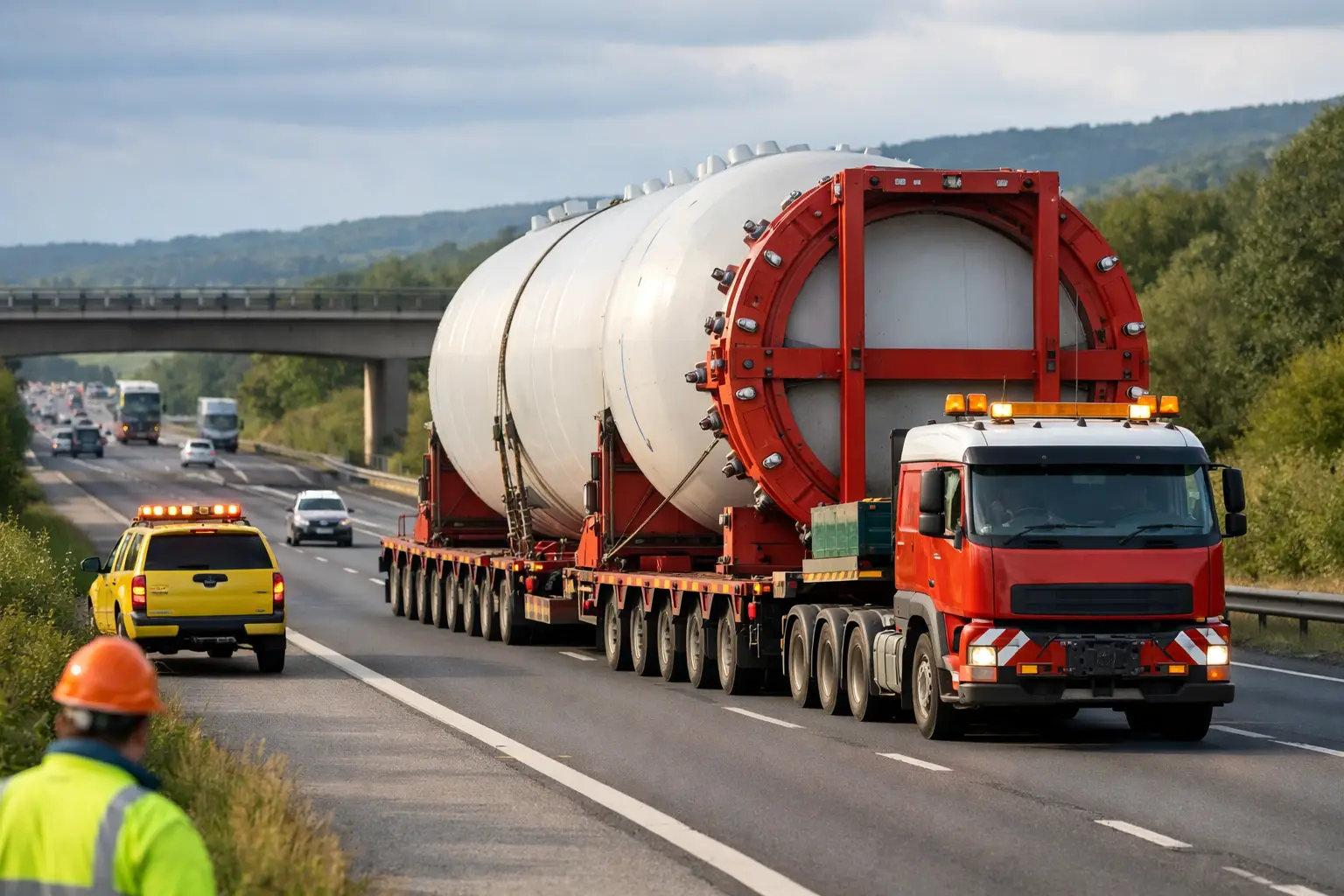
A consignment can be too long for a standard van, too awkward for a pallet network, or too valuable to risk through several depots. In those situations, oversized load transport UK is not simply a matter of finding a bigger vehicle. It is about planning every point where the load could be delayed, damaged or refused – then putting one accountable transport team in charge from collection to completion.
For a construction component needed on site, a shop-fitting display due before an opening, or a large printed installation required for an event, the cost of getting it wrong is rarely limited to the delivery charge. A missed slot can hold up contractors, labour, equipment and a whole programme of work. Direct, dedicated transport gives you control when the consignment cannot be treated like ordinary freight.
What Counts as an Oversized Load?
Oversized does not always mean an abnormal load in the legal sense. Often, it means an item that is outside the practical limits of conventional courier and parcel services. It may be long, wide, tall, heavy, fragile, unbalanced, difficult to secure or impossible to move safely by hand.
Examples include long steel sections, machinery, exhibition stands, large-format printed materials, retail fixtures, architectural panels, generators, crated equipment and unusually shaped prototypes. A load can also become operationally oversized when access is restricted. A compact item may need a tail lift, forklift support or a vehicle that can load from above because there is no suitable loading bay.
This distinction matters. A large item does not automatically require the same arrangements as a statutory abnormal load. However, it always requires the right vehicle, loading method, route and delivery plan. Assuming that a standard courier can ‘make it fit’ is where avoidable problems start.
Oversized Load Transport UK: The Details That Matter
The vehicle is only one part of the job. Before collection, an experienced transport provider should establish the exact dimensions, weight and centre of gravity where known. They should also understand whether the item can be forklifted, whether it needs to remain upright, how it is packaged, and whether it needs protective packing or specialist restraint.
Accurate information allows the vehicle to be matched to the load rather than guessed at. A long-wheelbase van may be ideal for lightweight, lengthy items. A curtain-sided or sliding-roof vehicle may be better where a forklift loads from the side or above. For heavier, larger consignments, a 7.5-tonne, 18-tonne or 26-tonne lorry may be appropriate, with mounted forklift capability where site equipment cannot be relied upon.
Access at both ends deserves the same attention. Is there a height restriction, narrow approach, timed gate, pedestrianised area or site induction? Can the receiving team unload immediately? Is there room for the vehicle to turn? These questions can feel minor during a rushed booking, but they determine whether a delivery arrives on time or waits outside a site while everyone looks for a solution.
For loads that fall within abnormal-load requirements, notifications, route restrictions and appropriate permissions must be addressed before the vehicle moves. The requirements depend on the dimensions, weight, route and local authority or police area involved. This is a situation for clear advice and careful planning, not assumptions.
Why Direct Delivery Protects the Load
Many freight networks are designed for volume. Items are collected alongside other consignments, moved through hubs, sorted, loaded again and sent out on multi-drop routes. That model can be economical for standard pallets and parcels, but every additional handling point creates another opportunity for damage, delay or loss of control.
An oversized or unusually shaped consignment is especially vulnerable to those risks. It may not stack safely, may require a particular orientation or may occupy space that a network operator is unwilling to guarantee. Even when accepted, its journey can be subject to changing depot schedules and delivery windows.
A dedicated service works differently. One vehicle collects your consignment and takes it directly to its destination. There are no depot transfers, no unrelated collections after loading and no unnecessary handling. The driver remains responsible for the load throughout the journey, while you receive clear progress updates and proof of delivery.
That approach is valuable when delivery timing is fixed. A shop fitter may have a narrow overnight access slot. A production line may be waiting for one replacement part. A legal, publishing or advertising team may need high-value materials delivered before a deadline that cannot move. In each case, the direct route is not a luxury. It is the practical way to reduce exposure.
Choosing the Right Vehicle and Equipment
The cheapest vehicle is not always the most cost-effective choice. Sending a vehicle that is too small can mean a failed collection, rushed repacking, damage or a second journey. Sending a much larger vehicle than required may increase cost and create access difficulties at the delivery point.
The best choice depends on the load and the job. A vehicle with a sliding roof can make crane or forklift loading straightforward. A mounted forklift can be decisive for rural sites, construction locations and premises without unloading equipment. A tail lift helps with heavy items where ground-level handling is possible, while trained drivers and suitable securing equipment protect fragile or high-value loads in transit.
It also depends on urgency. A scheduled transport service may suit a planned installation or regular distribution route. If a component is urgently needed to prevent downtime, immediate collection and same-day dedicated delivery may be the safer option. The right plan is the one that protects both the consignment and the consequence of late arrival.
Information to Provide Before Booking
Good transport planning starts with a proper brief. Share the length, width, height and weight of the consignment, alongside photographs where possible. Explain its packaging, lifting points, handling restrictions and whether it can be stacked or tilted.
You should also provide collection and delivery postcodes, named contacts, opening hours, booking references and any access constraints. If a site needs a particular type of vehicle, a driver induction, PPE or a delivery slot, say so at the outset. The more accurately the requirement is described, the more confidently it can be planned.
Do not overlook the receiving side. A delivery is only complete when the item is safely handed over to the right person in the right condition. Confirm who will be available, what unloading equipment is on site and whether the load needs placing in a specific area. For high-value or sensitive consignments, agree the handover process before collection.
A Reliable Option for Complex UK Deliveries
Redhead Couriers supports businesses and private customers who need more than a standard collection and drop-off. Its owned-and-operated fleet ranges from small vans to 26-tonne lorries, allowing the transport method to be matched to the consignment, access requirements and deadline. Dedicated vehicles, trained drivers and real-time tracking keep the journey visible and controlled.
This is particularly useful for organisations across Essex, Suffolk, London and the wider UK that cannot afford to leave a large, fragile or time-critical delivery to a multi-drop network. Whether the item is heading to a construction site, retail unit, exhibition venue, manufacturing facility or private address, the aim is straightforward: collected properly, carried safely and delivered on time.
When an oversized load is due to move, treat the first conversation as part of the transport operation. A few minutes spent confirming the load, vehicle, route and unloading plan can protect days of work at the other end. Speak to a dedicated Transport Consultant early, and the delivery can be arranged with the certainty the job deserves.