
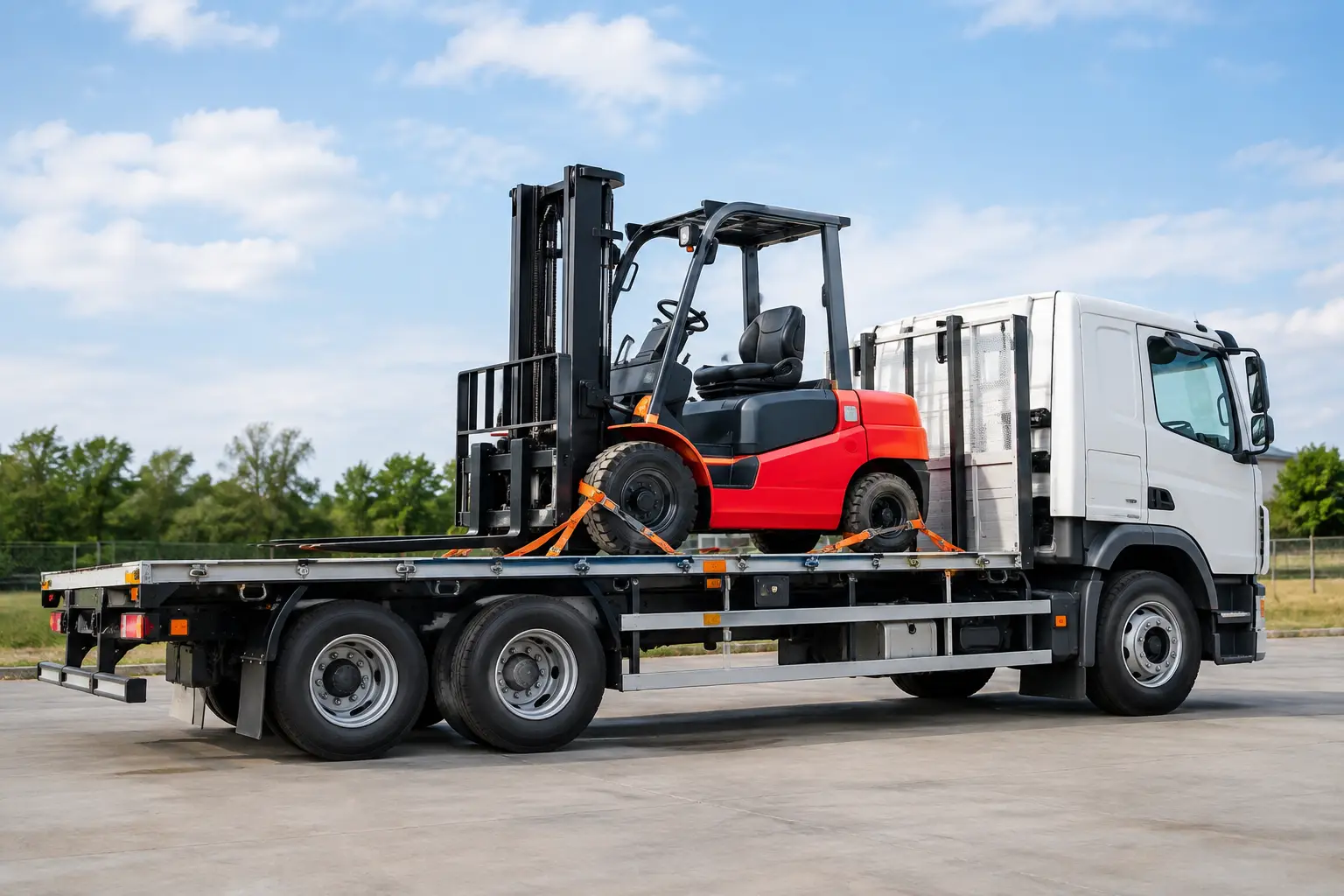
A load can reach site on time and still fail to be delivered. If there is no forklift, no loading bay or no trained operator waiting at the kerbside, pallets, timber, machinery and building materials may remain on the lorry while work stops around them. Lorry mounted forklift delivery solves that problem by bringing the unloading equipment with the vehicle.
For businesses working to fixed installation slots, construction programmes or production deadlines, that extra capability is not a luxury. It is often the difference between a completed delivery and an expensive delay. A dedicated vehicle, matched to the consignment and operated by a trained driver, keeps control in one place from collection through to proof of delivery.
What is lorry mounted forklift delivery?
A lorry mounted forklift is a compact forklift carried on the rear of a lorry. Once the vehicle arrives, the driver can safely remove the forklift and unload the consignment without relying on equipment at the delivery address. You may also hear this type of machine referred to by the name Moffett, although the important point is the capability rather than the label.
This service is designed for loads that are too heavy, bulky or impractical to unload by hand, but where a crane, telehandler or site forklift cannot be guaranteed. It is particularly useful for palletised goods delivered to building sites, trade counters, industrial units, rural locations and premises without a loading dock.
The vehicle still needs suitable access and a safe place to operate. A mounted forklift does not remove every site constraint, but it gives the delivery team far more independence than a standard curtainsider or box lorry arriving with no unloading solution.
When a mounted forklift is the right answer
The best transport choice depends on the load, the location and what must happen once the vehicle arrives. A forklift-equipped lorry is often the practical option when a consignee cannot provide mechanical handling, or when relying on them to do so creates too much risk.
Construction suppliers may need blocks, bagged materials, insulation or structural components placed where site teams can receive them. Manufacturers may need raw materials delivered to an outbuilding with limited handling equipment. Shopfitters may need fixtures, flooring or display materials unloaded at a new retail unit before a planned overnight installation. In each case, the delivery is only successful when the goods are safely off the vehicle and available for the next stage of work.
It can also be valuable for urgent replacement parts. A damaged machine component is of little use if it arrives quickly but cannot be unloaded until the following day. Bringing the right vehicle and the right handling equipment avoids turning an urgent transport booking into a waiting game.
Why dedicated transport gives you more control
A pallet network may be suitable for routine, flexible freight. It is not always suitable for a high-value, awkward or time-critical load that needs a specific vehicle and controlled handling. Network freight can involve multiple handling points, depot transfers and delivery windows that are too broad for a live site or booked installation.
With a dedicated lorry mounted forklift delivery, one vehicle collects your consignment and takes it directly to its destination. There are no unnecessary depot moves and no multi-drop route placing other deliveries ahead of yours. The driver knows what they are carrying, the unloading requirement and the delivery plan before setting off.
That direct approach matters where timing is tight. It also reduces handling, which is particularly important for fragile materials, specialist equipment and goods that are difficult to re-palletise if damaged. Tracking and clear communication give your team a realistic view of progress, rather than leaving someone at site repeatedly chasing an estimated arrival time.
Planning the delivery before collection
A mounted forklift provides flexibility, but safe delivery begins well before the lorry arrives. The transport provider needs enough information to select the correct vehicle, confirm payload and assess whether access will support both the lorry and forklift operation.
Dimensions, weight, number of pallets and the nature of the load all matter. So does the condition of the collection and delivery areas. Narrow entrances, low bridges, soft ground, steep gradients, parked vehicles and overhead cables can affect the plan. A lorry may fit through a gate but still lack room to turn, park safely or deploy the forklift.
Before booking, be ready to confirm:
- the total weight, dimensions and number of items or pallets;
- collection and delivery postcodes, plus any access restrictions;
- whether goods need unloading to ground level or moved to a specific point;
- the required delivery time and whether someone will be present to receive the load.
Photographs of restricted entrances, site plans and a named contact at each end can prevent avoidable surprises. If the delivery point is a working construction site, ask whether there are induction requirements, booking systems, PPE rules or designated unloading zones. The more clearly the job is planned, the more confidently the driver can complete it.
Safe unloading is more than having a forklift
A mounted forklift must be operated by a trained, competent driver under suitable conditions. The ground needs to be stable, the working area needs to be clear, and pedestrians must be kept away while unloading takes place. There are also limits on what the forklift can lift and where it can travel.
For example, a pallet may be within the lorry’s carrying capacity but too unstable, too tall or incorrectly packed for safe fork handling. Long loads, loose materials and unusual shapes may require a different restraint method, packaging solution or vehicle arrangement. This is where practical transport advice is worth having before the vehicle is dispatched.
The delivery team should also be clear about the final unloading point. Kerbside delivery, placement immediately inside a gate and movement across a large site are very different tasks. A forklift can place goods efficiently, but it cannot safely travel across unsuitable terrain or substitute for equipment required to lift materials to upper floors.
Choosing the right vehicle for the job
A mounted forklift lorry is one specialist option within a wider fleet. The right choice may be a smaller vehicle for restricted urban access, a larger lorry for heavier loads, or a vehicle with a sliding roof when goods must be loaded by crane at collection. Vehicle matching should reflect the whole operation, not simply the load weight.
For deliveries into London and other controlled areas, emissions requirements and route planning also deserve attention. Using an appropriately specified vehicle and an experienced driver helps prevent an otherwise straightforward job being disrupted by access restrictions, compliance issues or an unsuitable delivery slot.
Redhead Couriers plans dedicated transport around the consignment, the route and the unloading reality at the destination. That means asking the questions standard courier networks often cannot accommodate, then assigning a vehicle that can complete the job safely and on time.
Common situations where delays can be avoided
Many delivery failures are predictable. A supplier sends goods to a site assuming a telehandler is available, but the machine has moved to another area. A customer books a standard pallet service to a rural unit, only to find the driver has no means of unloading. A shop fitting crew is waiting overnight, but the delivery arrives during the day on a multi-drop route with no certainty around its final arrival time.
A dedicated forklift-equipped delivery changes the arrangement. The transport is scheduled around the required time, the vehicle carries its own unloading capability, and one accountable team manages the consignment from collection to completion. It does not eliminate the need for site preparation, but it removes one of the most common causes of failed deliveries.
For urgent work, it is sensible to state the consequence of a missed slot when requesting a quote. If a production line, installation team or building programme depends on the load, that information helps shape the collection time, route and contingency planning. Transport is not simply about moving an item from A to B. It is about protecting the work that depends on it arriving safely.
When your goods need more than a driver opening the rear doors, arrange the vehicle around the real delivery conditions. A properly planned lorry mounted forklift delivery gives your team a far better chance of seeing the load unloaded, received and ready for work when it matters.