
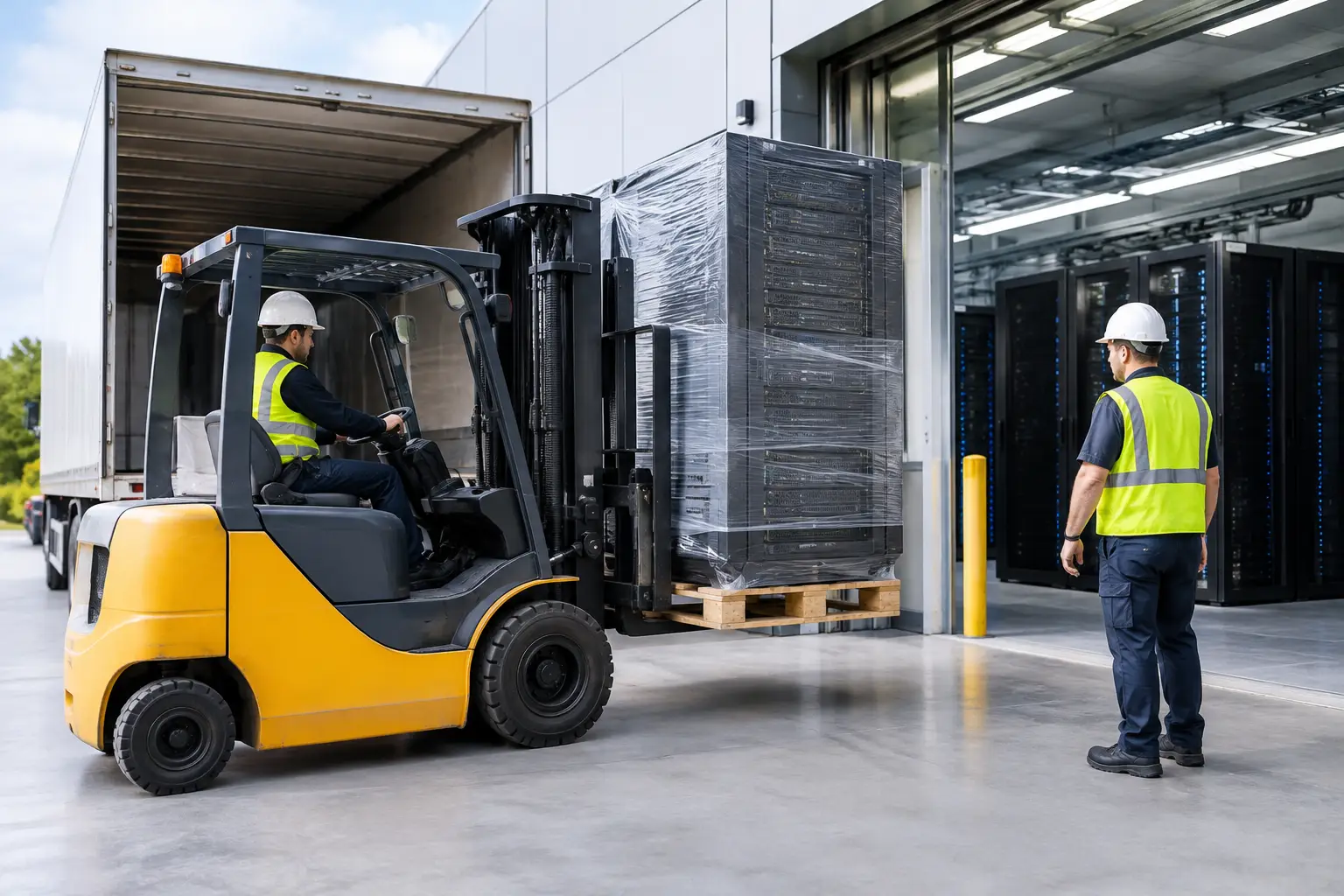
A data centre equipment delivery example is rarely just a case of moving boxes from A to B. A replacement server, UPS unit, network cabinet or cooling component may be needed within hours to protect a live operation. It may also need to arrive at a secure site with a booked slot, named engineer, precise vehicle instructions and a clear chain of custody.
For that type of job, the delivery method matters as much as the destination. Standard parcel and pallet networks are built around hubs, shared loads and multiple handling points. Dedicated transport is built around control: one vehicle, one important delivery, collected directly and taken straight to site.
A practical data centre equipment delivery example
Imagine an IT infrastructure provider in Essex receives an urgent call from a customer in London. A network storage array has failed, and a replacement unit is ready at the provider’s warehouse. The customer has a maintenance window that starts at 19:00, and their data centre will only accept the consignment between 18:15 and 18:45.
The unit is valuable, fragile and too large to treat as an ordinary parcel. It is packed in a protective flight case, secured on a pallet and accompanied by serial-number records. The collection point has a forklift available, while the delivery site has a raised loading bay but requires the driver’s details and vehicle registration in advance.
A dedicated courier service begins by confirming the facts that determine whether the job can be completed safely: the collection and delivery postcodes, item dimensions, weight, packaging, loading equipment, delivery deadline and named receiving contact. Access restrictions matter too. A central London data centre may have height limits, security barriers, restricted stopping arrangements or a pre-booked goods-in procedure.
In this example, a suitable vehicle is allocated rather than simply sending the first available van. Depending on the size and weight of the storage array, this could be a Luton van with a tail lift, a larger vehicle with a mounted forklift, or a curtain-sided lorry for bulkier equipment. The right choice reduces handling at both ends and avoids the costly mistake of arriving with a vehicle that cannot unload.
The driver collects directly from the warehouse, checks that the case is secure and that the paperwork matches the consignment. Once loaded, the equipment is restrained using appropriate securing equipment to prevent movement in transit. It is not added to a multi-drop route, transferred through a depot or handled by several different teams.
The customer receives live progress updates while the vehicle travels to the data centre. If traffic, road closures or site access create a risk to the booked slot, the transport team can respond early, rather than discovering the problem after a missed delivery. At the site, the driver reports to security, follows the agreed delivery procedure and obtains proof of delivery from the authorised recipient. The IT team can then move the equipment into its next stage of installation knowing where it has been and who has handled it.
Why direct transport suits data centre equipment
The cost of the equipment is only one part of the risk. A delayed delivery can extend downtime, leave engineers waiting on site and push critical work outside an agreed maintenance window. In some cases, a failed component can affect services relied on by thousands of users.
Direct delivery gives the sender a single accountable transport partner from collection to handover. There are fewer touchpoints, fewer opportunities for the packaging to be damaged and a much clearer answer to the question, “Where is it now?” For time-sensitive hardware, that visibility is operationally useful, not merely reassuring.
It also allows the job to be planned around the actual equipment. A rack-mounted UPS, for example, may be dense and heavy for its footprint. A cabinet may be awkward because of its height. A crate containing optical or network equipment may need particular care despite being relatively light. The vehicle, loading method and route should reflect those differences.
That does not mean a dedicated vehicle is always necessary. A well-packaged, low-value consumable with no fixed deadline may be suitable for an ordinary carrier. The decision changes when timing, value, dimensions, handling requirements or the consequences of failure become significant.
Planning the delivery before collection
The best urgent deliveries are prepared quickly, but not casually. A short, accurate briefing can prevent delays that no amount of fast driving will solve later. Before booking, the sender should have the key information ready:
- the exact dimensions, weight and number of items
- whether the equipment is crated, palletised or in flight cases
- loading and unloading facilities at both locations
- the required collection time and delivery window
- site contact names, telephone numbers and security requirements
- any vehicle restrictions, including height, weight or access limits
- whether the recipient needs a call before arrival
For high-value equipment, it is sensible to record serial numbers and take condition photographs before dispatch. This helps with receiving checks and gives both parties a clear record should there be any query later. If the item is not adequately packaged for road transport, say so at the outset. A transport consultant can advise on the practical options, but packaging and safe handling arrangements should never be assumed.
Data centre sites can present their own complications. Security teams may require driver identification in advance. A delivery bay may be shared with other contractors. The goods-in point may be different from the main entrance, and the site may refuse access outside a tightly controlled slot. These are planning details, but they can decide whether a delivery arrives on time.
Vehicle matching is not a minor detail
A small van is efficient for compact, protected equipment that can be loaded by hand. A Luton van with a tail lift is often more appropriate for palletised hardware where no forklift is available at one end. For oversized items, heavier loads or equipment that needs mechanical support on site, a larger lorry and specialist capability may be required.
The vehicle should be selected for the whole journey, not only the collection point. A 26-tonne lorry may be ideal for a heavy generator-related component, but unsuitable for a site with restricted urban access. Conversely, using a smaller vehicle for a large cabinet can mean extra handling, poor loading conditions or an aborted delivery. The practical answer depends on the consignment and the route.
Redhead Couriers operates a varied owned-and-operated fleet, from small vans to 26-tonne lorries, allowing the transport plan to follow the job rather than forcing the job into a standard network process. Where a delivery needs a sliding roof, tail lift or mounted forklift, this can be discussed before the vehicle is dispatched.
Security and proof of completion
Data centre deliveries often involve equipment that is commercially sensitive as well as expensive. The protective measures should therefore continue beyond careful loading. Direct transport reduces exposure by avoiding unnecessary depot transfers and shared vehicle handling. Trained drivers, real-time tracking and a clear delivery record add further control.
Proof of delivery should confirm more than that a vehicle reached the postcode. For a planned data centre delivery, the record should identify the receiving person or team, the time of handover and any exception noted at the point of delivery. If site staff ask for equipment to be left unattended, that should be referred back to the sender or agreed contact rather than treated as a routine drop-off.
There is also a useful distinction between delivery and installation. A courier can bring equipment safely to the agreed goods-in point or receiving area, but specialist positioning, unpacking, rack installation and connection may require the customer’s engineers or a separate technical team. Agreeing that boundary in advance prevents confusion at a critical moment.
When same-day delivery is the safer choice
Same-day dedicated delivery is particularly useful when a replacement part is holding up repairs, a site has a narrow change window or equipment cannot spend a night in a shared carrier depot. It is also a sensible option when a supplier needs confidence that a fragile or unusually shaped item will travel directly to a named recipient.
The goal is not simply speed. It is controlled movement from the moment the equipment leaves the sender until it is signed for at the destination. For data centre teams, that control protects schedules, reduces uncertainty and gives engineers the best chance of starting work when planned.
When a delivery carries that level of consequence, provide the full brief early and choose transport that can take ownership of it. The right vehicle, a trained driver and direct handover can make the difference between a planned maintenance window and an avoidable delay.