
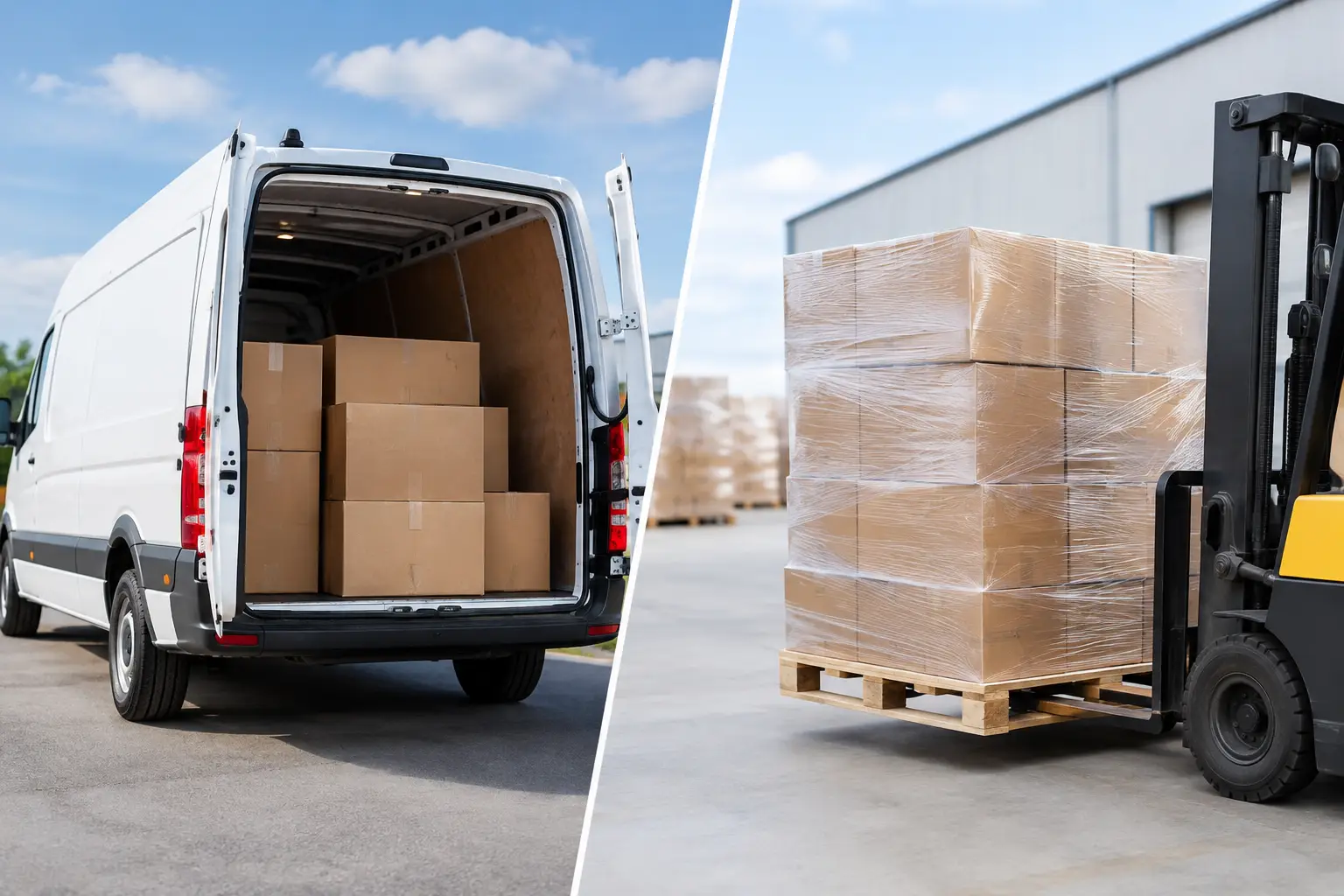
A consignment can fit neatly on a pallet and still be completely wrong for a pallet network. When comparing dedicated van versus pallet delivery, the deciding factor is rarely just size or price. It is whether the delivery can tolerate depot handling, shared vehicle space, variable transit times and less direct control.
For a replacement machine part needed on site before a crew is sent home, a set of exhibition graphics required for a morning build, or fragile shop fittings with a booked delivery slot, the answer is usually clear. The goods need one vehicle, one trained driver and a direct route. For stock replenishment that can move over several days without special handling, pallet delivery may be the sensible option.
The right choice protects more than the goods. It protects your programme, your customer relationship and the cost of disruption.
Dedicated van versus pallet delivery: the real difference
Dedicated van delivery means a vehicle is assigned solely to your consignment. It is collected, loaded securely and driven directly to its destination, with no unrelated freight added to the journey. There are no sorting hubs, depot transfers or planned multi-drop rounds between collection and delivery.
Pallet delivery generally means goods are secured to a pallet and moved through a shared freight network. The pallet may be collected by one vehicle, taken to a depot, sorted with other consignments, transferred to a regional hub and loaded onto a final delivery vehicle. This model is designed for efficient movement of standardised freight, particularly where timing is flexible and a lower transport cost matters more than direct control.
Neither service is automatically better. They solve different problems. A pallet network can be an efficient choice for stable, non-urgent goods with predictable dimensions. A dedicated vehicle is built for consignments where delay, damage or uncertainty would cost more than the transport itself.
It is also worth separating the pallet from the service. A pallet is a loading method, not a guarantee of how freight will travel. A palletised load can travel in a dedicated van or lorry when direct delivery is required. Equally, an item that is not palletised can be moved safely in a dedicated vehicle if it needs careful loading and restraint.
When pallet delivery makes commercial sense
Pallet delivery is often well suited to regular, planned distribution. A manufacturer sending standard boxed stock to a warehouse, a wholesaler replenishing a retailer, or a business moving durable materials on a two-to-five-day service can benefit from the shared-network model.
Because vehicle capacity, collection routes and depot operations are shared between customers, the price is commonly lower than booking a vehicle exclusively. That can be the right commercial decision when the delivery date is flexible, the goods are properly packed and the receiving point has suitable access for a pallet vehicle or tail-lift delivery.
However, the lower headline cost should be considered alongside the operational conditions. Network freight is likely to be moved more than once. Each handover creates another point at which labels, packaging, booking details and handling instructions must be correct. A missed connection at a depot can also affect the planned delivery date, even when collection happened on time.
For routine freight, these risks may be manageable. For a one-off item that is difficult to replace, they may not be.
When a dedicated van is the safer choice
A dedicated van is the stronger option when the consignment has a consequence attached to it. Perhaps a construction site needs a component before a crane booking expires. Perhaps a legal team requires documents delivered securely to meet a filing deadline. Perhaps a print run must reach a venue before doors open, or a client has given a strict timed slot for valuable display equipment.
Direct transport gives you control over the route, the vehicle and the delivery plan. The driver collects your goods and remains responsible for them until proof of delivery is obtained. Tracking updates can be shared as the journey progresses, so your team and recipient are not left guessing where an essential item is.
This is particularly valuable for fragile, high-value, oversized and awkwardly shaped consignments. Standard pallet-network operations rely on goods being packed and presented to suit an efficient shared system. That is not always possible with glass panels, bespoke joinery, delicate prototypes, long lengths, exhibition stands or equipment that cannot be stacked.
A dedicated service allows the vehicle to be matched to the load. A small van may be right for urgent documents or boxed parts, while a larger vehicle can accommodate site materials, machinery or palletised freight. Where access, unloading or load shape calls for more specialist planning, options such as sliding-roof vehicles and mounted forklifts can make the difference between a straightforward delivery and an avoidable site delay.
The handling question many buyers miss
The journey is only part of the risk. Handling is often where a delivery becomes vulnerable.
A pallet travelling through a network may be loaded, unloaded, scanned, stored and reloaded across several locations. This is normal for the service model, but it is not ideal for goods that are sensitive to knocks, tilting, weather exposure or stacking pressure. Even strong outer packaging has limits when freight is moved repeatedly among large volumes of other loads.
With a dedicated vehicle, handling can be limited to collection and final delivery. The driver can assess the load at collection, secure it appropriately and keep it in position for the whole journey. That continuity matters where instructions are specific, such as keeping an item upright, avoiding stacking, delivering to a named person or calling ahead before arrival.
It also makes accountability much clearer. If a question arises, there is one transport provider managing the collection, journey and handover, rather than several stages across a network.
Timing: planned economy or immediate response?
Pallet delivery normally works to service bands rather than a precise vehicle departure. Collection may take place on one day, with delivery planned for the next working day or later. Even premium pallet services can be influenced by cut-off times, depot schedules and capacity across the network.
Dedicated transport is different. It can be arranged for immediate collection, a pre-booked collection time or a timed delivery. Once loaded, the vehicle goes to the required UK destination rather than waiting for a consolidation schedule. For urgent work, this is often the only practical way to recover a delay or meet a fixed deadline.
That does not mean every delivery needs a same-day vehicle. Booking a dedicated service for low-value, non-urgent stock would often be unnecessary. The question is what happens if the goods arrive late. If the answer is lost labour, a failed installation, a missed event, contractual pressure or an unhappy customer, direct delivery deserves serious consideration.
Choosing the right service for your consignment
Before booking, assess the delivery against the realities of the job rather than simply comparing rates. Four questions usually provide a clear answer:
- Can the goods safely tolerate multiple handling points and depot transfers?
- Is the delivery date flexible, or does it need to arrive at a specific time?
- Would delay or damage stop work, create extra cost or affect a customer commitment?
- Does the load need a particular vehicle, careful restraint, specialist unloading or a driver who can follow detailed instructions?
If the answers point towards flexibility, standard packaging and low consequence, pallet delivery may be a sensible fit. If they point towards urgency, vulnerability or a fixed deadline, a dedicated vehicle provides the control you need.
Access is another practical consideration. A pallet service may require a forklift, pallet truck access, a loading bay or a suitable kerbside location at the delivery point. A dedicated transport provider can plan around the collection and delivery environment, selecting a vehicle and equipment appropriate for a restricted site, a city-centre address or a location without conventional loading facilities.
Paying for certainty, not just transport
The comparison should not be reduced to the collection price. A shared pallet service can offer excellent value where its operating model matches the job. But when a delivery goes wrong, the real cost is often found elsewhere: installers waiting on site, production standing still, a retail launch delayed or a replacement item needing to be sent at short notice.
Dedicated transport costs more because the vehicle, driver and route are reserved for your delivery. In return, you gain a direct journey, controlled handling, live visibility and a clearer chain of responsibility. For urgent or business-critical work, that is not an added luxury. It is the service specification that prevents a routine delivery from becoming an operational problem.
Redhead Couriers works with customers across Essex, London and the UK to assess those details before the vehicle is assigned. The aim is not to sell more vehicle than you need, but to make sure the chosen service protects the consignment and the commitment behind it.
When the next delivery is being planned, start with the consequence of getting it wrong. If the goods can move through a shared network without putting the job at risk, pallet delivery may do exactly what is required. If they need to arrive tracked, safe and on time with no unnecessary handling, a dedicated vehicle gives you a much stronger position from the moment it is collected.