
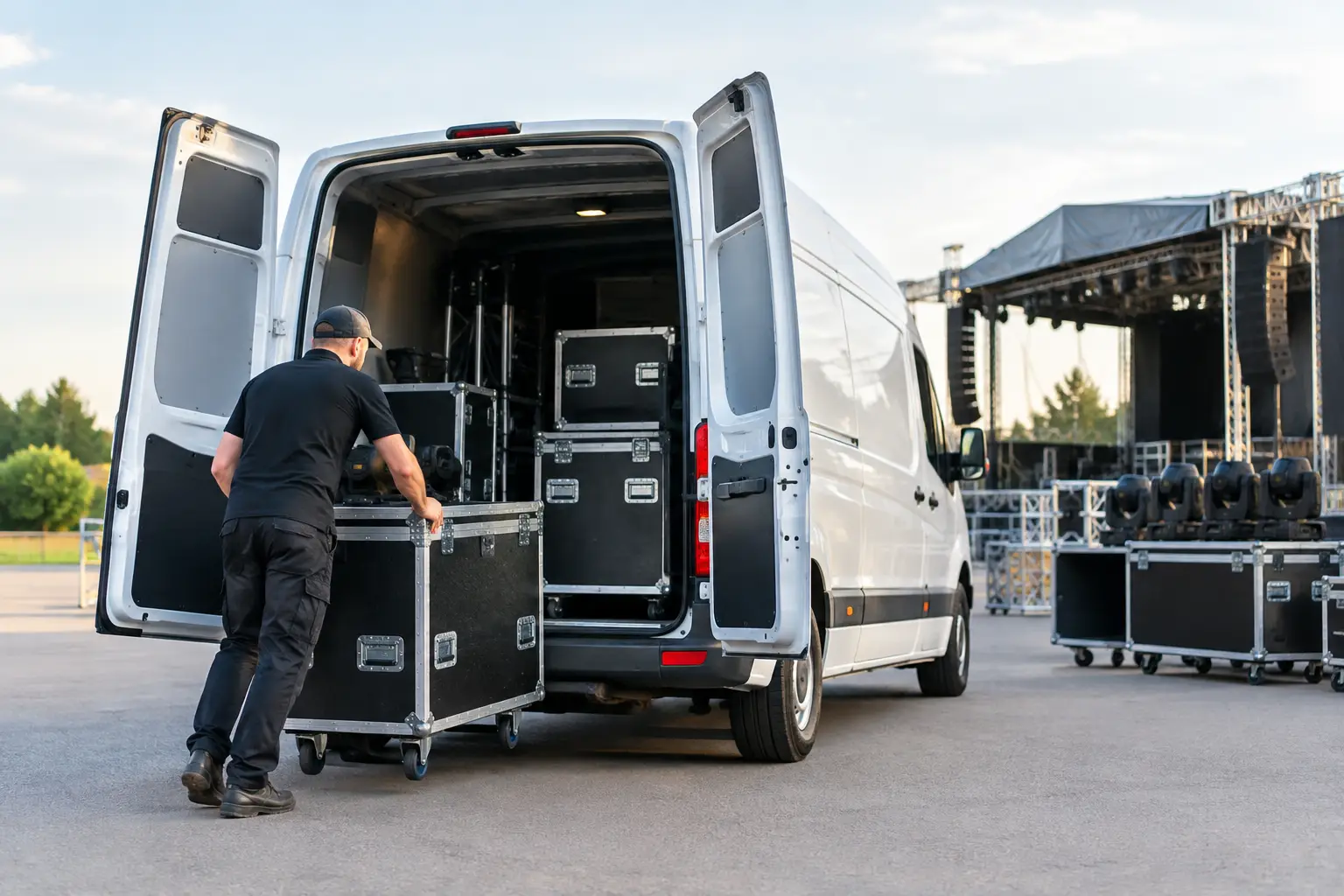
A show stand that arrives after the doors open is not simply late. It can mean an unbuilt space, an idle events team, lost footfall and a difficult conversation with a client. The best transport for event equipment is therefore rarely the cheapest standard delivery option. It is the service that gives you control over collection, handling, timing and delivery right through to the venue.
For exhibition contractors, marketing teams, production companies and retailers running a launch, event logistics need to work around a fixed deadline. Equipment may be expensive, fragile, awkwardly shaped or needed at a specific loading bay during a narrow access slot. A dedicated vehicle and trained driver turn those risks into a managed delivery.
What makes the best transport for event equipment?
Event equipment does not behave like ordinary parcels. It may include exhibition stands, printed panels, lighting, audio-visual equipment, product samples, display furniture, staging, cables, branded stock or flight cases. Often, several of those items need to arrive together, in the right condition and at the right entrance.
The most dependable option is usually dedicated transport: one vehicle collects your consignment and takes it directly to its destination. There are no depot transfers, no multi-drop route and no repeated loading and unloading between collection and delivery. Your equipment remains under the care of the same vehicle and driver until it reaches the venue.
That matters because every additional handling point introduces a chance of delay, loss or damage. A pallet network or parcel carrier can be suitable for routine, well-packaged stock with flexible delivery times. It is less suitable when an exhibition opens tomorrow morning, a roadshow has one chance to set up, or a replacement screen is needed before delegates return from lunch.
Direct delivery also gives the organiser a clearer line of accountability. You know who has collected the goods, where they are and when they are expected to arrive. Real-time tracking and proof of delivery provide the confirmation that operational teams need when the pressure is on.
Start with the event deadline, not the vehicle
Choosing the right transport begins with the delivery plan. Before selecting a van or lorry, establish the venue’s build timetable, loading bay rules, booking reference, access restrictions and the name and number of the person receiving the equipment. Major venues can have strict slots, height limits and waiting restrictions. A driver arriving early may still be unable to unload without the correct booking.
Work backwards from the time the final item must be on site. Allow time for loading at collection, traffic, driver breaks where relevant, venue check-in and unloading. If the equipment needs building or testing, it should arrive well before the opening time rather than at the point your team needs it.
For same-day work, an immediate dedicated collection can be the practical answer. For planned exhibitions and conferences, a timed or scheduled delivery is often better. It gives the venue a reliable arrival window and gives your team time to arrange labour, passes and access.
Return movements deserve the same attention. At the end of an event, stands, stock and equipment are often released alongside hundreds of other consignments. A pre-booked collection prevents valuable items being left unattended or held in a venue’s storage area longer than necessary.
Match the vehicle to the load and the venue
Vehicle choice affects more than capacity. It determines whether the goods can be loaded safely, whether the driver can access the venue and how much handling is required on arrival.
A small van may be ideal for urgent documents, replacement graphics, promotional stock or a compact flight case. A larger van can accommodate multiple cases, display units and a modest stand. For bulky exhibition systems, staging, shop-fit materials or a larger volume of event stock, a curtain-sided vehicle or lorry may be more appropriate.
When equipment cannot be lifted through conventional rear doors, specialist vehicles make a material difference. A sliding-roof vehicle can support top loading by crane or forklift. A mounted forklift can help where the collection or venue has no unloading equipment. These details should be agreed before collection, not discovered when the vehicle is already at the gate.
Dimensions and weight must be accurate. Measure the longest, widest and tallest item, including packaging, and identify anything that cannot be stacked. Tell your transport provider about glass, screens, loose components, wheeled cases, unusually long items and goods that must remain upright. Good advice at the booking stage can avoid a vehicle arriving that is technically large enough but unsuitable for safe loading.
Controlled handling protects the equipment and the schedule
Event equipment is frequently hired, branded or built for a specific campaign. Damage is not just an inconvenience. A cracked display panel, missing connector or damaged plinth can make the entire installation unusable.
Secure loading begins with suitable packaging and a clear inventory. Flight cases, protective corners, blankets, straps and careful load restraint all have a role, depending on the item. Fragile pieces should not be left to shift in transit, and small but essential components should be labelled and kept with their related equipment.
A trained driver should understand the agreed handling requirements and load the consignment with the delivery sequence in mind. If the first items needed at the venue are buried behind everything else, unloading takes longer and increases the risk of rushed handling. For a multi-item event delivery, sensible positioning in the vehicle saves valuable minutes at the other end.
The destination also needs consideration. Does the driver need to deliver to a loading bay, a goods-in point, a stand location or a named representative? A kerbside handover is very different from a booked delivery to an exhibition hall. Be clear about what the venue permits and what assistance is available on site.
When a standard courier may not be enough
Standard courier networks are built for volume. Goods may travel through several depots, be sorted with other consignments and move on vehicles serving numerous delivery addresses. That model can offer an economical solution for ordinary parcels, but it does not offer the same control for deadline-critical event freight.
Dedicated transport is worth considering when the delivery has a fixed time, the contents are high value or fragile, the load is oversized, or the full consignment needs to travel together. It is also the safer choice where a missed slot would lead to extra venue charges, installation delays or a cancelled appearance.
There are occasions when a split approach makes sense. Non-urgent leaflets or giveaway items can be sent in advance through a conventional service, while the core stand, electronics and last-minute materials travel by dedicated vehicle. The right choice depends on the consequences of delay, not simply the size of the box.
Questions to ask before booking event transport
A good transport partner should ask practical questions rather than promise a price before understanding the job. Be ready to confirm:
- the collection and delivery postcodes, contact names and available times;
- the exact dimensions, weight and number of items;
- any fragile, valuable, oversized or non-stackable equipment;
- venue access rules, loading bay bookings and delivery deadlines; and
- whether unloading support, specialist equipment or a return collection is required.
These details allow the correct vehicle, route and handling plan to be arranged from the start. They also make it easier to provide useful tracking updates to colleagues, exhibitors or clients who need reassurance.
A direct route gives your event team room to work
The best event transport does more than move boxes from A to B. It protects the build schedule, reduces unnecessary handling and keeps a responsible driver focused on one important delivery. For businesses that cannot risk a depot delay or a multi-drop detour, this is the difference between hoping the equipment arrives and knowing it is being looked after.
Redhead Couriers provides dedicated UK transport for time-critical, fragile, oversized and unusual event consignments, with vehicles matched to the job and delivery tracked from collection to completion. If an event deadline is fixed, speak to a Transport Consultant early with the load details and venue requirements. The right plan is easiest to put in place before the loading bay becomes the next problem.