
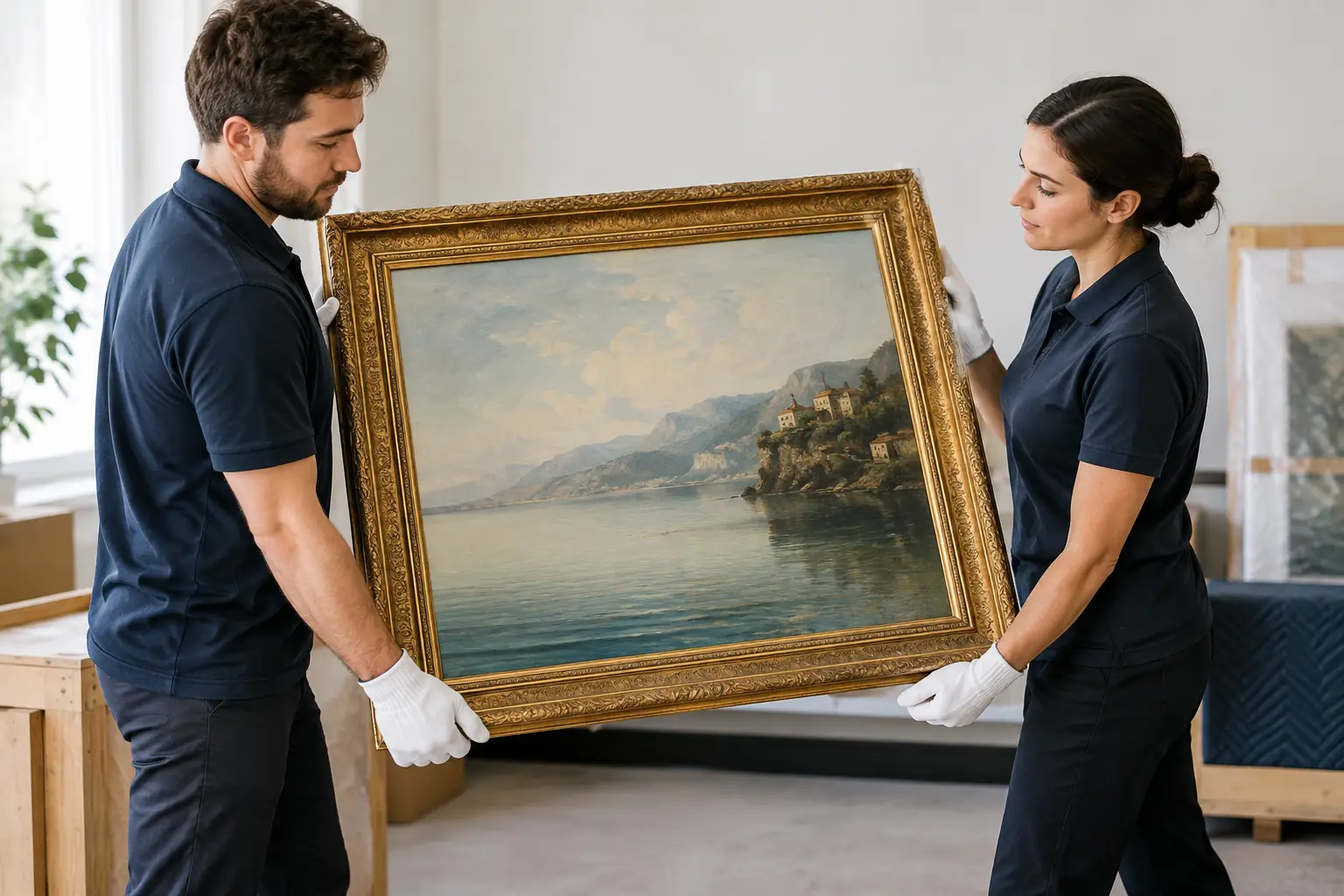
A framed oil painting can look secure on a gallery wall yet become vulnerable the moment it is carried through a doorway. Corners catch, glazing flexes, canvases can be punctured and a sudden stop in transit can turn a minor movement into costly damage. To move fragile artwork safely, the handling plan matters as much as the packaging.
This is especially true when the piece is valuable, oversized, insured, irreplaceable or needed at a precise time. A standard parcel network is built around sorting belts, depots and repeated vehicle changes. Artwork often needs the opposite: controlled collection, appropriate protection, a properly matched vehicle and one accountable team from collection to delivery.
Assess the artwork before it is packed
Start with a proper condition check. Photograph the front, back, frame corners, fixings and any existing marks in good light. If the artwork is going to a client, exhibition, auction house, conservator or new premises, these images create a clear record of its condition before transport.
Check how the piece is constructed rather than assuming every frame or canvas can be handled in the same way. A glazed frame has different risks from an unglazed canvas. A heavy gilt frame may be structurally delicate at its joints. A sculpture may have a stable base but vulnerable projections, while a mixed-media piece could react badly to pressure, heat or vibration.
Measure the artwork once it is protected, not only when it is bare. Add the depth of corner protection, board, wrapping and any crate to your measurements. This avoids the common problem of booking a vehicle that accommodates the artwork in theory but leaves too little room to load and secure it correctly.
Use protection that suits the piece
Packing should stop movement without placing pressure on the artwork itself. For framed paintings, protect the corners first, then place a clean protective layer over the face. A rigid board can shield the front from knocks, particularly if there is glass, but it should not be taped directly to a frame or allow adhesive to touch the artwork.
Bubble wrap can be useful around an outer layer, but it is not a universal answer. Wrapping it tightly against an oil painting, varnished surface or delicate finish can create marking or adhesion risks, particularly in warm conditions. It should never be the only protection for a valuable framed work.
For larger or higher-value pieces, a purpose-built crate is often the sensible choice. A crate provides rigidity and makes controlled lifting easier, but it must be made to the correct internal dimensions and include suitable cushioning. Too much empty space allows the item to shift. Too little can put pressure on a frame, canvas or sculpture.
When several pieces are travelling together, pack and load them so they cannot touch. Paintings should be separated with protective boards and secured upright where appropriate. Do not stack framed artwork flat unless the item, packaging and loading plan specifically allow for it. The weight of another item, even one that appears light, can damage glazing or distort a frame over distance.
Plan the collection and delivery route
The journey begins before the vehicle arrives. Confirm access at both ends, including narrow doors, staircases, lifts, parking restrictions and the distance from vehicle to entrance. A large artwork may be perfectly manageable in a gallery but impossible to turn through a tight corridor without a different route or additional handling support.
Tell the transport provider whether collection or delivery is timed. A piece required for an installation, press event, shop opening or legal presentation may have a fixed window, not simply a preferred delivery day. This changes the transport plan. It may call for immediate collection and direct delivery rather than an economy service that leaves timing dependent on a wider route.
Environmental exposure also deserves attention. Artwork should not be left in an unattended vehicle, on a loading bay or outside a building while access is arranged. Rain, condensation, excessive heat and rapid changes in temperature can all be damaging, even when the outer packaging looks intact.
Why dedicated transport is safer for artwork
The greatest risk to fragile artwork is often not the miles travelled. It is the number of times the item is handled. In a multi-drop network, consignments may pass through several depots, be scanned onto different cages or pallets, and be loaded alongside goods with entirely different handling requirements.
Dedicated transport removes much of that exposure. One vehicle collects the artwork and takes it directly to its destination, without depot transfers or unrelated deliveries in between. The driver can load the piece with its dimensions, weight and fragility in mind, then keep it secure for the whole journey.
That does not mean every item needs a dedicated vehicle. A small, low-value print that is properly packaged may be suitable for another method. But where a damaged delivery would interrupt a project, harm a client relationship or create an insurance issue, the lower handling count is a practical form of risk control.
At Redhead Couriers, the one-vehicle, one-delivery approach is designed for exactly these consignments. Collection, route and vehicle can be planned around the piece, whether that means a compact van for a single framed work or a larger vehicle for exhibition panels, sculptures and display equipment travelling together.
Match the vehicle and loading method to the job
A vehicle should provide more than enough floor space. It needs safe loading access, suitable securing points and room for the driver to work around the consignment without forcing it through a narrow gap. For a long framed piece, an unusually shaped sculpture or a packed crate, the right vehicle can be the difference between a straightforward collection and a risky compromise.
When loading, keep the artwork away from doors, loose equipment and items that could shift under braking. Use clean blankets, protective boards and appropriate restraints, with restraints securing the outer packaging or crate rather than bearing directly against the artwork. Heavy objects should never be loaded in a position where they can lean on or slide into fragile pieces.
For unusually large work, access to a sliding-roof vehicle or mounted forklift may be needed. This is not about using bigger equipment for the sake of it. Mechanical support can reduce manual handling risk where a crate is heavy or where the collection point has a loading area suited to it. The correct method depends on the piece, the packing and the site conditions.
Give the driver clear handling instructions
Labelling a box ‘fragile’ is not a handling plan. Provide practical instructions: which way up the artwork must travel, where it can be lifted, whether it contains glass, whether it should stay upright, and who must sign for it at delivery. If there are installation deadlines or site-specific rules, share these before collection.
It also helps to name a contact at each end who can answer a call promptly. A driver delayed outside a secure site or waiting for a lift booking can lose valuable time, particularly on timed deliveries. Clear contact details and a confirmed delivery point keep the handover controlled.
For higher-value work, ask for real-time tracking and proof of delivery. Tracking allows the sender to update a gallery, client or site manager without guessing where the item is. Proof of delivery closes the chain of custody with a recorded handover.
Avoid the shortcuts that cause damage
Many avoidable incidents come from good intentions applied too quickly. Carrying a large frame by its top rail, resting a painting face-down on an uneven surface, using household tape directly on a finished frame or filling a van around the artwork after it has been loaded can all create problems.
Avoid arranging transport based on price alone when the item has a specific handling requirement. The cheapest option may involve multiple stops, standardised loading or restrictions on the size and shape of the consignment. Ask how many times the artwork will be transferred, what vehicle will collect it and whether it will travel directly.
If the piece is exceptionally valuable, historically significant or visibly unstable, speak to a specialist art handler or conservator before it moves. Transport can be arranged around their recommendations. The aim is not to overcomplicate a straightforward job, but to recognise when specialist assessment is the sensible safeguard.
A well-planned artwork delivery should feel uneventful: the right protection, the right vehicle, careful loading, direct travel and a confirmed handover. That quiet certainty is what keeps the attention on the artwork itself, where it belongs.