
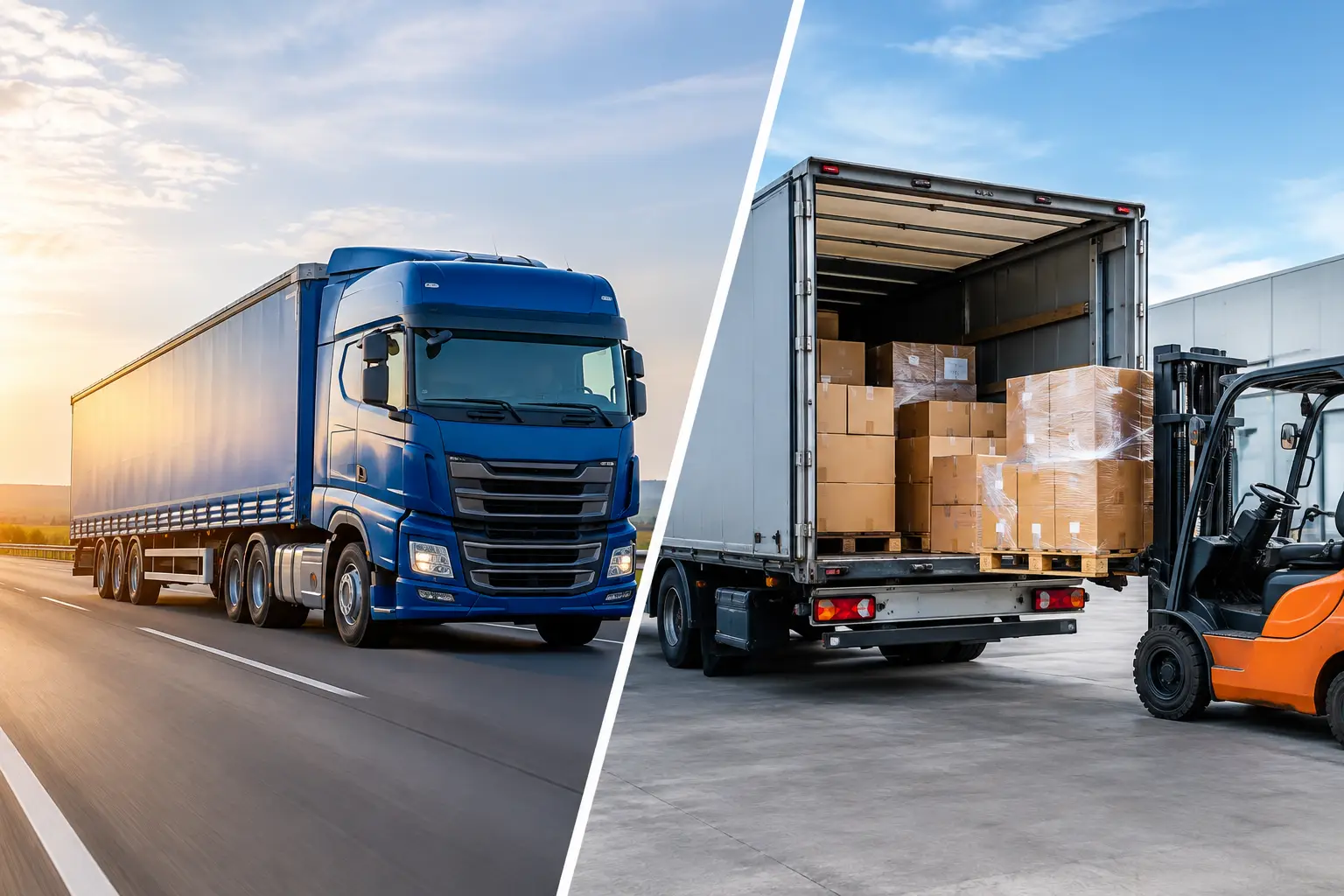
A production line is waiting for one replacement component. A shop fitting team has booked a night shift. A signed legal bundle must reach chambers before a hearing. In situations like these, the choice between dedicated transport versus groupage freight is not simply a question of price. It determines who handles the consignment, how predictable its journey is and what happens if the delivery cannot be late.
Both services have a proper place in UK logistics. Groupage can be an efficient way to move standard freight when the delivery window is flexible. Dedicated transport gives you direct control when the item, deadline or destination needs special attention. The right answer depends on what is at stake if something goes wrong.
What dedicated transport means in practice
Dedicated transport assigns a vehicle and trained driver to your consignment alone. The vehicle collects from your site and travels directly to the agreed delivery point, with no unrelated collections, depot transfers or multi-drop route to complete first.
That does not always mean a small van. The vehicle should be selected around the load and the job: an urgent document may need a car or small van, while machinery, exhibition materials, long lengths, fragile displays or palletised stock may require a Luton, curtain-sided vehicle or 26-tonne lorry. Specialist equipment, including sliding roofs or mounted forklifts, can also change what is possible at collection and delivery.
The practical benefit is clear: one vehicle, one important delivery. There are fewer handovers, fewer loading cycles and a direct line of responsibility from collection through to proof of delivery. For a time-critical job, the driver can leave immediately and work to the route and delivery time agreed with you.
How groupage freight works
Groupage freight combines smaller consignments from several customers in one vehicle or trailer. A carrier collects freight, consolidates it with other loads and moves it through a planned network. It may pass through one or more depots before final delivery.
This model makes good economic sense for routine pallet freight and non-urgent commercial stock. By sharing vehicle space and transport costs, businesses can send smaller loads without paying for a whole vehicle. For regular replenishment where a delivery date is acceptable rather than an exact time, it can be a sensible option.
The trade-off is control. Groupage schedules are built around network efficiency, not one consignment’s deadline. Your goods may be loaded, unloaded, sorted and reloaded alongside other freight. If a collection runs late, a depot is congested or an onward vehicle is delayed, the impact can travel through the network.
Dedicated transport versus groupage freight: the key differences
The biggest difference is not the vehicle size. It is the delivery model.
With groupage, your consignment shares capacity, route planning and handling points with other customers’ freight. With dedicated transport, the vehicle and driver are assigned to your job. That distinction affects speed, handling, security and communication.
Speed and delivery certainty
Groupage is generally planned around service bands such as next-day or economy delivery. Even where a carrier offers an estimated arrival date, a precise time is often difficult to guarantee because the final route can change as other freight is added or removed.
Dedicated transport is suited to immediate collection, same-day delivery, timed arrival and scheduled movements. If a construction site has a booked crane slot, a printer needs stock before a press run or a retailer cannot open without a display unit, a direct vehicle removes the waiting built into a hub-and-spoke network.
A dedicated service cannot remove road closures, accidents or severe weather. What it does provide is active control. The route can be monitored, the recipient can be updated quickly, and decisions can be made around the delivery rather than around a wider network timetable.
Handling and condition of goods
Every additional transfer creates another opportunity for damage, loss or delay. This matters particularly for fragile items, high-value equipment, awkward shapes, presentation-sensitive materials and goods that cannot be stacked.
Groupage freight is normally designed for standardised, suitably packaged loads. Pallets, cartons and wrapped goods that can tolerate mechanical handling are usually a better fit than a bespoke display, glass panels, antiques or precision equipment. Proper packaging still matters, but it cannot remove all risk created by repeated movement through depots.
Dedicated transport keeps handling to a minimum. Goods are loaded once, secured for the journey and unloaded at the destination. The driver who collects the consignment remains accountable for delivering it. For loads with particular loading requirements, the vehicle can be matched in advance instead of forcing the consignment into a standard network process.
Security and visibility
For confidential documents, product launches, valuable samples or specialist equipment, knowing where an item is matters as much as knowing when it should arrive. In a groupage network, tracking may show depot scans and planned milestones, but it does not usually offer direct control of the journey.
A dedicated vehicle provides clearer visibility. Real-time tracking, direct contact and delivery confirmation allow the sender to keep customers, site teams or colleagues properly informed. There is also less exposure to unplanned handling or access by multiple operatives.
This is particularly useful when a recipient has strict site rules, needs a delivery reference checked, or must be present to sign. A direct driver-to-delivery approach is easier to manage than asking a multi-drop network to accommodate a changing site instruction at short notice.
Cost and value
Groupage is often cheaper on the initial quote because you pay for a share of capacity rather than exclusive use of a vehicle. Where freight is standard, well packaged and not urgent, that saving can be entirely appropriate.
Dedicated transport costs more per movement because the vehicle, driver, fuel and time are reserved for your job. But the cheapest transport option can become expensive if it causes a failed installation, missed event, idle labour, replacement stock or a damaged item. The comparison should include the cost of disruption, not just the carriage charge.
For recurring planned deliveries, a transport consultant can help decide where groupage is suitable and where direct transport protects the operation. Many businesses use both. Routine stock may move through a groupage network, while urgent exceptions and sensitive loads are sent dedicated.
When groupage is the sensible choice
Choose groupage when the consignment is standard, securely packaged and does not need a fixed arrival time. It is well suited to routine pallets, replenishment stock and lower-risk commercial freight where a next-day or economy service is acceptable.
It is also a sensible option when the delivery point has flexible receiving hours and no special unloading requirement. If a day of delay would be inconvenient but not commercially damaging, sharing transport capacity may offer good value.
The key is to describe the freight accurately. Dimensions, weight, packaging, stackability and any restricted items should be declared before booking. A load that is awkward, fragile or over-height may not be suitable for a conventional groupage route, even if its overall weight appears modest.
When dedicated transport is the better decision
Dedicated transport becomes the safer choice when the delivery has a non-negotiable deadline, a high consequence of failure or handling requirements outside a standard network. That includes urgent parts for manufacturing, shop fittings needed for an opening, advertising materials for a campaign, court papers, exhibition assets and fragile or oversized goods.
It is equally valuable when collection needs to happen now rather than at the next planned carrier cut-off. A direct vehicle can collect from offices, warehouses, suppliers, construction sites and private addresses, then travel straight to the recipient anywhere in the UK.
Redhead Couriers is built around this model, matching the vehicle and driver to consignments that need controlled handling, tracked progress and a direct delivery route. For customers, that means a single accountable transport partner rather than a parcel label entering an unfamiliar network.
Questions to ask before you book
Start with the deadline. Does the recipient need the item at a specific time, or is delivery on a given day enough? Then consider the consequence of delay. If people, equipment or a customer commitment are waiting, direct transport may be the lower-risk choice.
Next, look closely at the consignment itself. Can it safely be moved through several depots? Is it stackable? Does it need two people, specialist restraint, a forklift, a sliding roof or careful positioning? Finally, check the destination. Construction sites, city-centre venues, restricted-access locations and timed booking slots often need more planning than a standard commercial delivery.
A good transport provider will ask these questions before recommending a service. That is not unnecessary administration. It is how the right vehicle, route and handling plan are put in place before the goods leave your premises.
When a delivery carries real operational weight, give the transport decision the same attention as the consignment itself. A quick conversation with a dedicated Transport Consultant can establish whether shared freight is sufficient or whether a direct, tracked vehicle is the sensible way to keep your delivery safe and on time.