
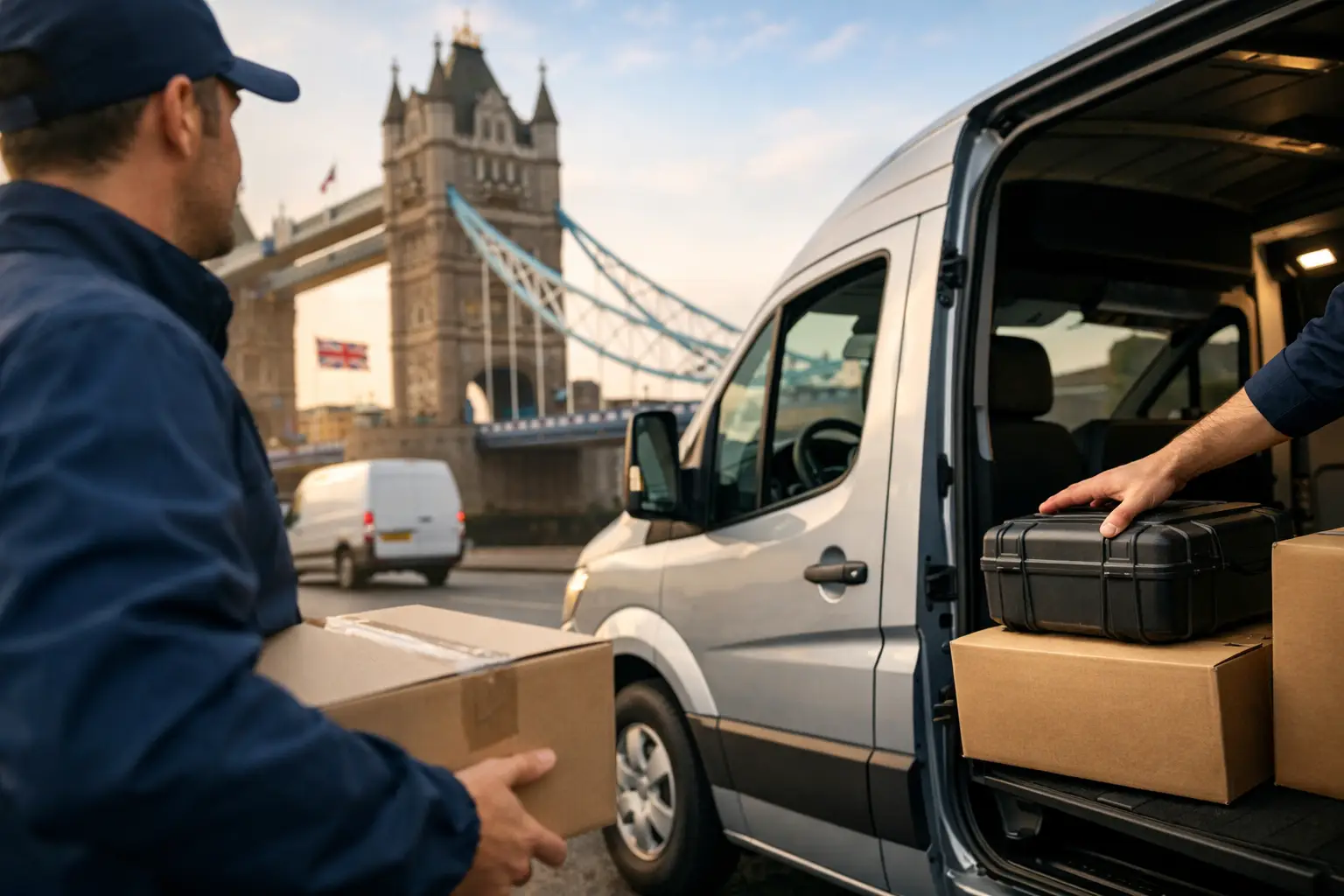
A missed component can stop a site team. A damaged display can delay a launch. A legal bundle arriving after a fixed deadline may have consequences far beyond the cost of transport. This UK direct delivery guide is for the occasions when a standard parcel service is not enough and one vehicle needs to take responsibility for one important consignment.
Direct delivery is straightforward in principle: your goods are collected, loaded onto a dedicated vehicle and driven directly to their destination. There are no depot transfers, no conveyor belts, no multi-drop route and no unnecessary handling between collection and proof of delivery. For urgent, fragile, high-value, oversized or unusually shaped items, that control changes the risk profile of the job.
What UK direct delivery means in practice
A direct delivery service assigns a suitable vehicle and trained driver to your consignment alone. The driver collects from your premises or another agreed location, secures the load and travels to the delivery point. You know who is carrying the item, where it is and when it has been delivered.
This differs from a parcel or pallet network, where goods may be collected with hundreds of other consignments, moved through one or more depots and placed on several vehicles before final delivery. That model suits routine shipments well. It can be cost-effective for boxed goods with flexible delivery times, but it is not built around a single item’s deadline, handling requirements or dimensions.
With dedicated transport, the plan is built around the consignment. If an item needs to arrive before a shop fit-out team begins work, be kept upright, protected from weather or unloaded with specialist equipment, those requirements can be agreed before collection rather than left to chance in a network.
When a dedicated vehicle is the sensible choice
Direct delivery is not necessary for every shipment. If you are sending standard cartons with no particular time pressure, a conventional next-day service may be the right commercial decision. The extra value of a dedicated vehicle becomes clear when delay, damage or uncertainty would cost more than the delivery itself.
It is commonly used for time-critical stock, replacement machinery parts, exhibition materials, print runs, retail fixtures, construction supplies and confidential documents. It also suits fragile items such as glass, artwork, prototypes and specialist equipment that should not be repeatedly unloaded and reloaded.
Dimensions matter too. Long lengths, awkward shapes and oversized loads can be difficult or impossible to put through a standard network. A transport consultant can match the consignment to the correct vehicle, from a small van for urgent documents or samples through to a 26-tonne lorry for larger loads. Where required, options such as sliding roofs and mounted forklifts can make collection and unloading practical at sites without conventional loading facilities.
The key question is not simply, “How quickly does it need to arrive?” Ask what happens if it arrives late, damaged or on the wrong vehicle. If the answer involves lost labour, a delayed project, a missed opening or an unhappy client, direct control is often the safer option.
Planning a direct delivery properly
The best urgent deliveries are planned with accurate information at the outset. A courier can respond quickly, but vehicle choice, loading method and delivery access all depend on the details supplied.
Start with the collection and delivery addresses, including postcodes, contact names and telephone numbers. Confirm the earliest collection time and the required arrival time, rather than using vague instructions such as “as soon as possible”. If there is a booked slot, site induction, security gate or restricted access period, say so before the vehicle is dispatched.
Give clear measurements and weight for every item. Include the length, width and height, not only the overall weight. Describe whether the consignment is boxed, palletised, crated, loose, delicate or likely to move during transit. Photographs can be useful for unusually shaped items, particularly where loading space or securing points need to be assessed.
You should also explain the handling requirement. Does the item need to remain flat, upright or dry? Is it high-value or confidential? Does it need two people to move it safely? Will a forklift, tail lift or mounted forklift be needed at either end? These are not small operational details. They determine whether the right vehicle and equipment arrive first time.
Check access at both ends
Many delivery problems occur at the final few metres rather than on the road. A lorry may be ideal for the load but unsuitable for a narrow lane, a low bridge, a residential restriction or a busy city-centre unloading point. Equally, a site may require a vehicle booking, PPE, a named driver or delivery through a particular entrance.
Confirm whether there is space to park and unload, whether someone will be present to receive the goods and whether the destination has suitable equipment. For London collections and deliveries, consider ULEZ requirements, loading restrictions and the extra time needed for congested routes. A properly planned route protects the delivery window and avoids an expensive aborted delivery.
Why fewer handling points mean lower risk
Every handover introduces another opportunity for delay, damage or confusion. In a multi-drop network, an item can be scanned correctly at every stage and still be exposed to the practical risks of sorting, stacking, depot movement and route changes.
Direct transport reduces those touchpoints. The same vehicle that collects the consignment carries it to the recipient. The driver can be briefed on its condition, securing requirements and delivery instructions. That continuity is especially valuable for items that cannot be easily replaced or where a customer needs confidence that the load has not been left unattended in a depot.
It also makes communication clearer. Instead of trying to trace a consignment through several operational stages, you have one accountable transport provider monitoring one journey. Real-time tracking and proof of delivery provide practical reassurance, while updates can be shared with site teams, clients or colleagues waiting for the goods.
Choosing the right level of urgency
Same-day does not always mean immediate, and immediate collection is not always necessary. The right service depends on your deadline and how much flexibility the receiving location has.
For a production line waiting on a part, immediate collection and direct travel may be appropriate. For a delivery that must arrive at 08:00 the following morning, a scheduled dedicated service can give better control while allowing sensible route and driver planning. Timed delivery is useful where access is only available during a narrow window, such as a retail handover, court appointment or booked installation.
Be realistic about journey time. Distance, traffic, driver hours, collection readiness and site access all affect the plan. A dependable courier will not promise an arrival time without considering these factors. Honest timing protects your operation better than a quick answer that cannot be delivered.
The questions worth asking before you book
Before committing to a direct delivery provider, establish whether the service is genuinely dedicated. Ask whether your consignment will stay on one vehicle, whether it will be transferred through a depot and how the provider will communicate progress. Confirm the collection window, delivery commitment, vehicle type and what proof of delivery will be supplied.
It is also sensible to ask about driver training, load security and the provider’s experience with your type of consignment. Construction materials, legal documents, display units and fragile equipment each present different risks. A provider that asks practical questions before quoting is usually trying to prevent problems rather than merely win the booking.
For recurring work, an account arrangement can bring consistency. Your usual vehicle requirements, collection points, delivery sites and handling instructions can be understood in advance, making urgent bookings faster and reducing the chance of critical information being missed.
A direct delivery service is an extension of your operation
A dedicated courier should feel less like a distant booking platform and more like an accountable part of your team. That means answering the phone when plans change, advising when a vehicle is unsuitable and keeping control of the consignment until it is safely received.
Redhead Couriers provides this one-vehicle, one-delivery approach for businesses and private customers across Essex, Suffolk, London and the UK. The focus is simple: match the vehicle to the job, protect the load, keep you informed and deliver on time.
When the item matters, provide the full picture before it is collected. The right transport plan can protect your deadline, your customer relationship and the goods themselves – from the first lift into the vehicle to the final signature at the door.