
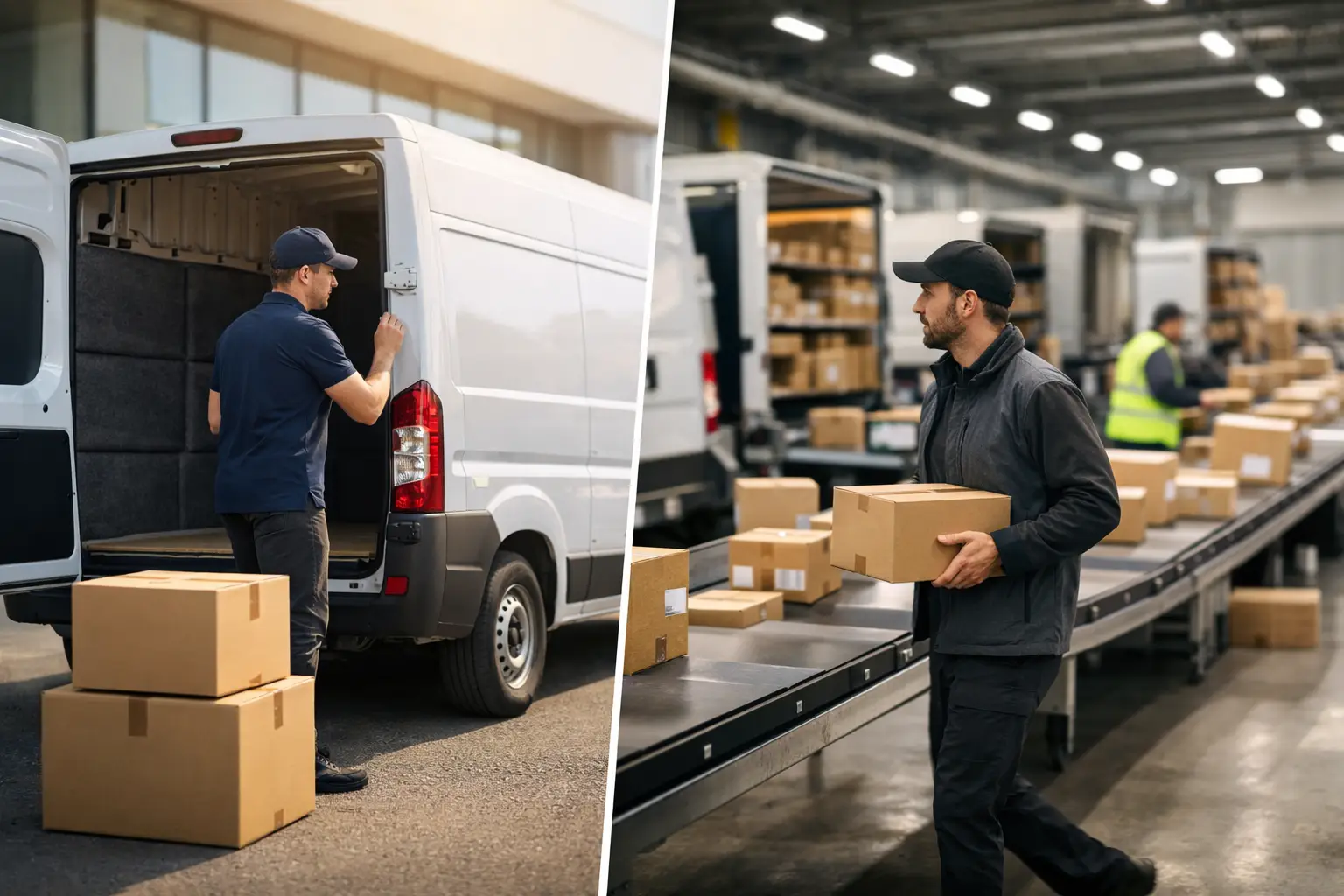
A production line is waiting for one replacement part. A shop fit-out cannot open until a display arrives. A signed legal document has a fixed deadline. In these situations, the choice between a dedicated vehicle vs parcel network is not simply about delivery price. It is about how much control you retain over an important consignment from collection to completion.
Standard parcel services are a sensible option for many routine, packaged deliveries. But they work by moving high volumes through shared hubs, sorting systems and multi-drop routes. When an item is urgent, valuable, fragile, oversized or difficult to replace, that model can introduce risks that are hard to manage after collection.
How parcel networks are designed to work
Parcel networks are built for scale. A parcel is collected or dropped at a depot, sorted alongside many others, transferred between hubs where necessary, loaded onto local delivery routes and delivered as part of a planned round. For small, well-packaged, non-urgent items, this is efficient and usually economical.
The trade-off is that the sender has less influence over the journey. Your consignment may be handled several times, loaded with unrelated goods and delayed if a depot misses a connection or a route runs behind schedule. Tracking can show progress, but it does not change the fact that the parcel is moving within a shared system.
This does not make a parcel network unreliable by default. It means the service is designed around a different priority: volume and standardisation rather than individual consignment control. If the delivery can wait until the next working day, fits normal size and weight limits, and is suitably protected in a carton, a network may be the right answer.
Dedicated vehicle vs parcel network: the practical difference
A dedicated vehicle service assigns one vehicle and trained driver to your delivery. The driver collects the consignment and takes it directly to the destination, without depot transfers, sorting belts, multi-drop diversions or handovers between depots.
That direct route changes the delivery process in several useful ways. The vehicle can be matched to the load, collection can happen immediately or at an agreed time, and the driver can be briefed on access restrictions, site contacts and handling requirements before setting off. You know who has the consignment, where it is and who is responsible for completing the job.
For a time-critical consignment, this can be the difference between a planned arrival and an estimated arrival. A same-day dedicated courier is travelling for your delivery, not fitting it around a route containing dozens of other stops.
There is a cost difference, of course. Hiring a dedicated vehicle will usually cost more than sending one standard parcel through a network. However, the correct comparison is not always the carriage charge alone. Consider the cost of a missed installation, idle engineers, a delayed launch, lost production time or having to remake a damaged item. For many business-critical deliveries, direct transport is the more commercially sensible option.
When a parcel network is likely to be enough
A parcel network is often suitable when the delivery is routine and the consequences of a delay are limited. This may include boxed stock replenishment, low-value samples, standard office supplies or documents that can arrive the following day without affecting an operation.
It is also a practical choice where the item is compact, securely packaged and within standard network dimensions. The recipient does not need a specific delivery time, and there is no special loading, unloading or site coordination to arrange.
Even then, packaging matters. A network parcel should be prepared for multiple touches, movement through automated sorting and stacking with other consignments. If the item cannot safely tolerate that journey, the apparent saving can disappear quickly.
When dedicated transport is the safer decision
Dedicated transport becomes particularly valuable when the delivery has no room for uncertainty. Urgency is one reason, but it is not the only one. Many consignments need direct control because of their shape, value or handling requirements.
Construction and shop-fitting teams may need materials, fixtures or replacement components delivered to a live site at a precise time. Manufacturing businesses may require a machine part before a production stoppage becomes expensive. Printers and publishers may need finished work collected and delivered without being bent, crushed or held overnight. Advertising teams often work to immovable campaign, event and installation dates.
A dedicated service is also appropriate for fragile equipment, artwork, prototypes, exhibition materials, legal documents and unusually shaped goods. These items may not fit standard network rules, or they may need to be loaded in a particular position and kept that way throughout the journey.
For private customers, the same principle applies. A valuable family item, delicate furniture piece or awkward purchase deserves more thought than a generic label and a depot conveyor. Direct transport provides a named, accountable route rather than hoping an unusual item will suit a standard process.
The hidden issue: handling points
Every additional handling point creates another opportunity for delay, loss or damage. In a parcel network, handling is fundamental to the model. The item may pass through collection cages, depot sortation, trunk vehicles, local depots and delivery vans before reaching its recipient.
With a dedicated vehicle, careful loading happens at collection and unloading happens at delivery. Fewer transfers mean fewer opportunities for an item to be placed incorrectly, separated from associated parts or exposed to avoidable movement.
This matters most for fragile and high-value consignments, but it also helps with complex jobs. If a delivery includes several components for one installation, keeping them together in one controlled vehicle can prevent the frustrating situation where most of the order arrives but one essential piece is still elsewhere in the network.
Vehicle matching is part of the service
Parcel networks generally ask goods to fit their system. Dedicated transport can fit the system to the goods. That starts with selecting the right vehicle, rather than assuming every delivery belongs in a small van.
A compact van may be suitable for urgent documents or small packages. A long-wheelbase van can accommodate larger equipment or multiple cartons. Larger loads may need a curtain-sided vehicle, a 7.5-tonne lorry or a 26-tonne lorry. For awkward items, specialist options such as sliding roofs or mounted forklifts can make collection and delivery safer and more practical.
The destination matters as much as the load. A central London site may have access restrictions, delivery booking rules or ULEZ considerations. A construction site may need offload support. A warehouse may require a timed slot and a vehicle with the right equipment. These are details worth resolving before collection, not when the driver is waiting at the gate.
Timing, tracking and proof of delivery
A network tracking page is useful for routine parcels, but updates may reflect scans at points in the network rather than a direct view of the vehicle’s route. If a deadline is critical, you need more than a broad delivery window.
Dedicated transport allows a collection and delivery plan to be agreed around your requirement. The driver can travel directly, with real-time tracking and clear communication if road conditions affect the journey. A delivery can be timed, scheduled in advance or arranged for immediate collection when an urgent problem arises.
Proof of delivery should also be clear. For high-value or commercially sensitive goods, knowing that the item has reached the correct person or location provides reassurance and a proper record for your customer, project manager or internal team.
Ask these questions before booking
Before choosing a service, assess the delivery rather than simply comparing rate cards. Ask whether the item can tolerate multiple handling points, whether it has to arrive at a fixed time and what happens financially if it is delayed or damaged. Consider its size, weight, value and shape, along with loading requirements and access at both ends.
Also ask who takes ownership if something changes. A standard network may have defined processes, but a dedicated transport provider can usually respond more directly to a late collection, changed site contact or urgent instruction because the vehicle and driver are assigned to your job.
Redhead Couriers provides that one-vehicle, one-delivery approach for consignments that need to be tracked, safe and on time. A Transport Consultant can help assess the load, route and vehicle before any commitment is made.
The right choice is rarely about whether parcel networks are good or bad. It is about matching the service to the consequences. If the delivery is standard and flexible, a network may be entirely appropriate. If it is the item that keeps a project moving, protects a client relationship or cannot be replaced by tomorrow, give it a vehicle of its own.