
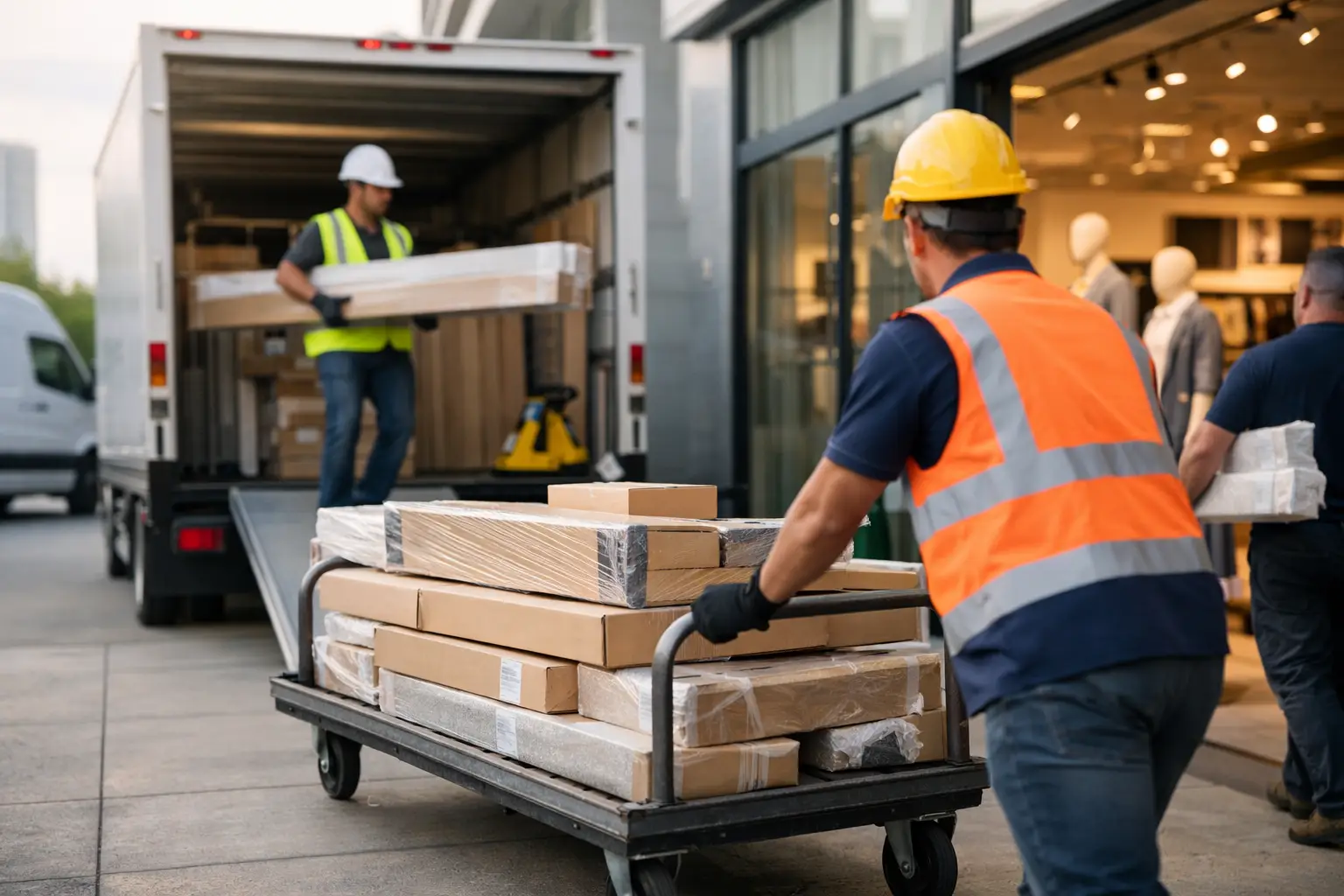
A missed shop fitting delivery does not just leave a few items waiting at the kerb. It can stop installers, delay a handover, disrupt a launch date and add avoidable cost to an already tightly planned programme. A dedicated shop fitting delivery service gives contractors, project managers and retail teams direct control over the journey – from collection to signed proof of delivery.
When shop counters, display units, glass panels, joinery, lighting, point-of-sale materials or specialist equipment need to arrive at a particular site and time, a standard parcel network is rarely the right answer. These consignments need the correct vehicle, careful loading and a driver who understands that delivery is only complete when the right person has received the goods in the right condition.
Why shop fitting transport needs direct control
Shop fitting work is driven by sequencing. One delayed component can hold up several trades. Flooring may be complete, but the joinery cannot be installed. Fixtures may be ready, but the visual merchandising team cannot begin. A delivery that turns up a day late, arrives without booking confirmation or is left unattended can quickly become a programme issue.
Multi-drop networks are built for volume and broad delivery windows. Goods may pass through depots, be loaded and unloaded several times, then travel alongside unrelated consignments. That model can suit routine cartons, but it introduces handling points and uncertainty that are not ideal for fitted furniture, branded display materials, awkwardly shaped components or items required for a fixed installation slot.
Dedicated transport works differently. One vehicle collects your consignment and takes it directly to its destination. There are no depot transfers, no unrelated drops and no hand-offs between drivers. The journey remains controlled, tracked and accountable from collection through to completion.
This matters particularly for projects in central London, busy retail parks, airports, shopping centres and live trading environments. Access restrictions, loading bay times and site contacts all need to be considered before the vehicle leaves. Good transport planning is not an extra administrative task. It is part of protecting the installation schedule.
What a shop fitting delivery service should handle
The right service starts by understanding the consignment and the site, rather than assigning the nearest available van. Size, weight, fragility, packaging, collection readiness and delivery access all affect the vehicle and loading method required.
A compact van may be suitable for urgent graphics, samples, hardware or boxed fittings. A larger vehicle can accommodate assembled furniture, long lengths of joinery, racking, counters or bulky promotional installations. For oversized or difficult loads, a 7.5-tonne, 18-tonne or 26-tonne lorry may be the safer and more practical choice. Sliding-roof vehicles can assist where crane loading is needed, while a mounted forklift may be appropriate where no unloading equipment is available on site.
The aim is not to send the biggest vehicle by default. It is to send the vehicle that protects the load, meets site restrictions and gives the project team sufficient capacity for the job. A poorly matched vehicle can cause damage, create unloading problems or turn a straightforward delivery into a last-minute scramble.
A capable provider will also establish the practical details before collection: whether the goods are palletised or loose, whether straps or blankets are needed, who will receive them, whether a timed slot has been booked and whether the site requires a named driver, vehicle registration or delivery paperwork in advance.
Direct delivery reduces handling risk
Shop fittings are often more vulnerable than they first appear. A wrapped counter can have delicate corners. A boxed light fitting may contain fragile internal components. Printed panels and branded graphics can be unusable after even minor crushing or water damage. Items with high replacement value may also be impossible to source quickly when a project is live.
Direct delivery reduces the number of times those items are moved. Trained drivers can secure the load correctly and keep it on the same vehicle until it reaches site. For high-value, fragile or unusually shaped goods, that control is a practical safeguard rather than a luxury.
It also gives the customer a clear line of responsibility. Instead of tracing a consignment through a network of depots and subcontractors, you deal with one transport team that can confirm collection, provide live updates and obtain proof of completion.
Timing is part of the delivery, not an afterthought
Same-day transport is valuable when an installation has already started and a key item is missing. A replacement fascia, urgent set of brackets, signage, tools or a damaged component can be collected and driven directly to site, helping the team recover time before the delay becomes more expensive.
However, not every shop fitting job needs an immediate vehicle. Scheduled and timed delivery is often the better option for planned installations, especially where a site has a strict booking system. The key is that the collection and delivery commitment should be clear. A vague all-day window is no help to an installation crew waiting for a critical load.
For early-morning site access, overnight preparation or out-of-hours work, transport must fit the programme rather than force the programme to fit the carrier. It depends on the project, location and site rules, but a dedicated vehicle gives far more flexibility than a conventional network service.
Real-time tracking and proactive communication are equally useful. Project managers should not have to chase for updates while coordinating trades, contractors and store personnel. Knowing the vehicle is collected, en route and approaching site helps people prepare the unloading area and keep the job moving.
Plan the collection as carefully as the delivery
The most reliable deliveries are prepared before goods are loaded. Make sure every item is clearly labelled with the destination, site contact and, where relevant, the unit number or loading bay reference. If there are several branches or projects running at once, use clear consignment details to avoid an expensive site mix-up.
Where possible, share accurate dimensions, weight and photographs of unusual items. This is especially helpful for long, heavy or unbalanced pieces, glass, bespoke joinery and items that cannot be stacked. It allows the transport consultant to select the right vehicle and advise on the safest loading approach.
Packaging still matters on a dedicated run. Direct transport limits unnecessary handling, but it does not replace proper protection. Corners should be protected, loose components secured and vulnerable surfaces covered. If the goods need to remain upright, that instruction needs to be explicit before collection.
At the delivery end, confirm whether the driver is delivering to a ground-floor loading bay, a service entrance or a restricted urban site. A courier service may deliver safely to site, but moving goods through a shopping centre, upstairs or into a retail unit can require additional labour, permits or site arrangements. Being clear about the required service avoids assumptions on the day.
When dedicated transport is the better commercial choice
It is tempting to compare delivery options only by the quoted price. Yet the cost of a lower-priced network service can change quickly if an item is damaged, delayed, misrouted or refused because the vehicle cannot access the site. The real comparison is between the transport cost and the cost of disrupting installers, rebooking access, replacing goods or missing an opening date.
Dedicated transport is particularly worthwhile when the consignment is urgent, irreplaceable, fragile, oversized, valuable or needed for a booked delivery time. It is also the sensible choice when several items must arrive together and in order, rather than being split across different vehicles and delivery days.
For repeat work, an account arrangement can bring useful consistency. The transport team becomes familiar with your sites, product types and preferred delivery process, while your team has a dependable point of contact when a planned job changes at short notice. Redhead Couriers supports this kind of ongoing requirement with a varied owned-and-operated fleet, trained drivers and direct UK-wide transport.
A delivery partner that protects the programme
Shop fitting programmes leave little room for uncertainty. The transport provider should be able to ask the right questions, match the vehicle to the load and take responsibility for the route from collection to delivery. That includes working responsibly in London and other controlled urban areas, with operational standards such as FORS Silver and ULEZ-compliant planning where required.
Before booking, provide the collection postcode, destination, required delivery time, item dimensions, weight, handling requirements and site contact. A dedicated Transport Consultant can then advise on the most suitable vehicle and service level, whether the need is an urgent same-day run or a carefully timed delivery for a major installation.
When the next fitting-out job depends on goods arriving intact and on time, choose transport that gives the consignment one vehicle, one direct journey and one accountable team looking after it.