
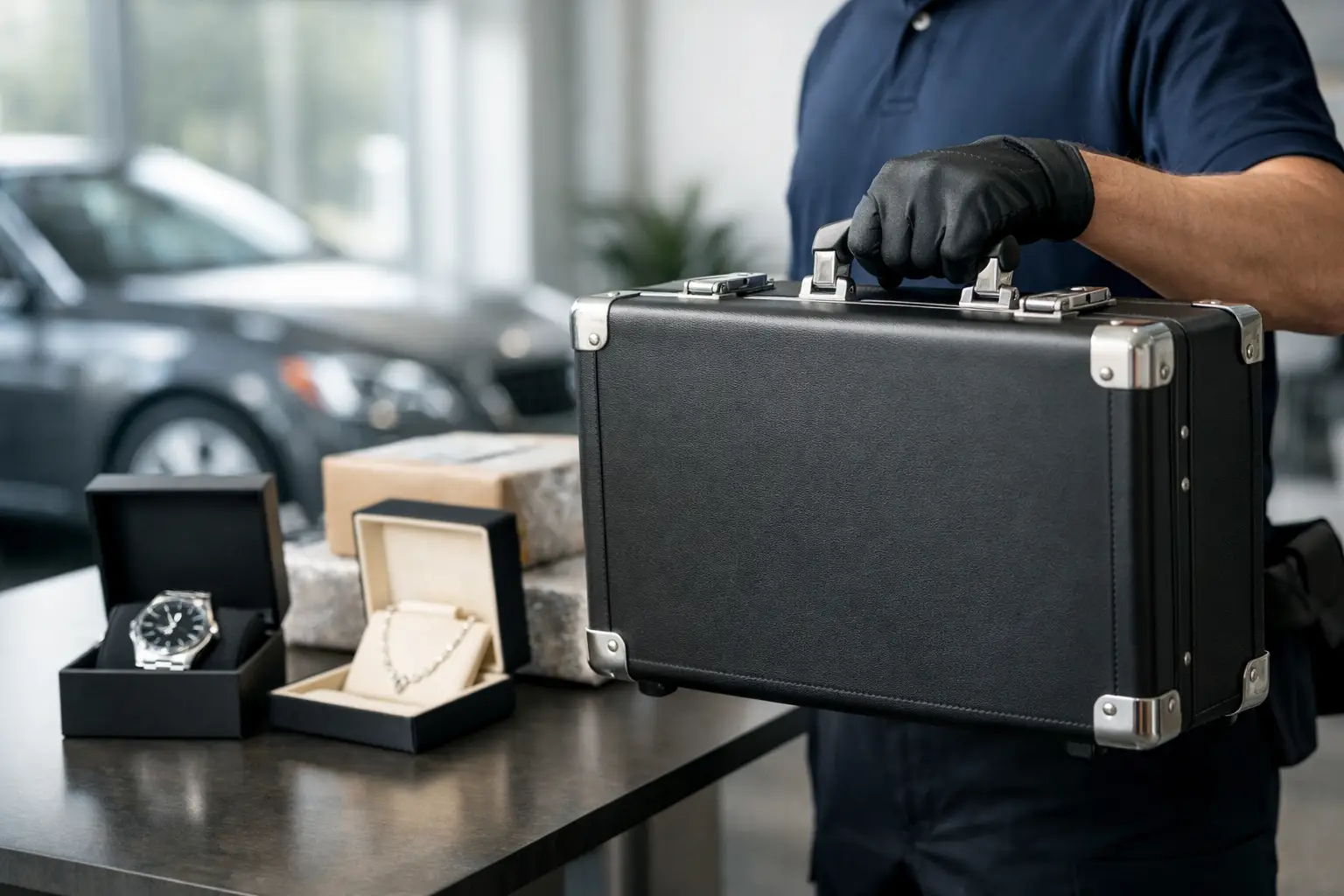
A signed contract needed in court by 10am. A one-off artwork heading to a gallery. A production component holding up an installation team. These are not parcels to put into a multi-drop network and hope for the best. A high value goods courier provides direct control when an item’s financial value, commercial importance or handling requirements make standard delivery a poor fit.
For many businesses, the real cost of a failed delivery is not the invoice value of the consignment. It is the fitter standing idle, the missed launch, the client relationship under pressure or the replacement item that cannot be sourced in time. The right transport service protects against those risks by keeping the journey simple: one suitable vehicle, one trained driver and one direct delivery.
What makes a high value goods courier different?
A conventional parcel network is designed for volume. Goods are collected alongside hundreds of other consignments, scanned through hubs, transferred between vehicles and placed on delivery routes with multiple stops. That model is efficient for ordinary packages, but every handover creates another opportunity for delay, loss or damage.
A dedicated high value goods courier works differently. Your consignment is collected into a vehicle assigned to its journey, secured appropriately and driven directly to the delivery point. There are no depot transfers, conveyor systems or unrelated deliveries between collection and destination.
That direct approach gives you practical advantages: a known collection time, a vehicle matched to the item, visibility while it is in transit and clear responsibility for delivery. It also means a driver can be briefed on the details that matter, such as a site contact, a restricted-access entrance, an upright-only requirement or a fixed delivery slot.
This is not only for items with a high insurance value. Sensitive documents, irreplaceable prototypes, exhibition materials, specialist tools and urgently needed machine parts can all be high-value consignments because of the disruption their loss or delay would cause.
When dedicated transport is the sensible choice
The need for a specialist service usually becomes clear when the consignment does not suit a standard label-and-sort process. It may be fragile, unusually shaped, too large for a parcel carrier or required at a precise time. It may also need discreet transport because of its contents or destination.
Legal and professional services often use dedicated transport for original documentation, court bundles and confidential material where a traceable chain of custody matters. Printers and publishers may need finished work delivered to an event, retailer or client on the day it is due. Shop fitters and construction teams rely on time-critical delivery of fixtures, displays, tools and replacement parts to keep work moving.
Manufacturers face a particularly sharp trade-off. A lower-cost network service may look attractive until a delayed component stops a line or misses a customer’s production window. In that situation, a same-day dedicated vehicle is not a luxury. It is the practical way to limit downtime.
Private customers also have good reason to choose direct delivery. Antiques, artwork, valuable furniture and personal items with unusual dimensions need careful loading and a service that does not treat them as another parcel in a cage.
Security starts before collection
Secure delivery is not simply a signature at the end of the journey. It begins with the booking conversation. A capable courier will ask the questions that determine whether the job can be completed safely: what is being moved, how is it packaged, what does it weigh, where will it be collected and delivered, and are there any access restrictions?
That information affects vehicle choice. A compact van might be right for urgent documents or boxed equipment. A larger van can accommodate bulky stock or protected display materials. For oversized loads, a 7.5-tonne, 18-tonne or 26-tonne lorry may be more suitable, particularly where loading equipment, a sliding roof or mounted forklift is needed.
Choosing too small a vehicle can result in rushed loading, poor restraint or a failed collection. Choosing an oversized vehicle can create access issues at a city-centre site or residential address. Good advice is therefore part of the service, not an add-on.
Once the vehicle arrives, the driver should check the consignment against the booking details and load it in a way that prevents movement in transit. Fragile goods may need protective packing and separation from other items. Tall or awkward pieces may need additional restraint. The handling plan depends on the item, which is why a one-size-fits-all delivery option rarely gives adequate protection.
Direct delivery reduces avoidable risk
The strongest protection for high-value goods is often reducing the number of things that can go wrong. A direct journey removes repeated loading and unloading, multiple delivery drivers and uncertain hub timings. It also allows a single accountable provider to monitor the job from collection through to proof of completion.
Tracking adds useful reassurance, particularly where a site team, client or recipient is waiting for the delivery. It allows customers to plan around the vehicle’s progress rather than chase a generic service update. For urgent work, clear communication can be as valuable as speed. If access changes, a contact is unavailable or a delivery point has specific procedures, the issue can be addressed while the vehicle is still en route.
A timed delivery should also be treated as a commitment, not a broad estimate. If an item must reach a London venue before doors open, a construction site before a lift is removed or a business before its receiving team leaves, the route and collection time need to be planned around that deadline. Traffic, loading restrictions and site access all matter.
Questions to ask before booking a high value goods courier
Price matters, but it should not be the only question. The lowest quote can be costly if it is based on a service with extra handling, a vague delivery window or a vehicle that is unsuitable for the load.
Ask whether the vehicle will be dedicated solely to your consignment and whether it will travel directly to the destination. Confirm who is responsible for collection, transit updates and proof of delivery. Explain the item’s dimensions, weight, fragility and packaging honestly, including anything that makes it difficult to lift or secure.
It is also worth clarifying the collection and delivery conditions. Does either location have stairs, loading bays, height restrictions, a booking-in procedure or limited parking? Is a forklift needed? Does the recipient need advance notice? These details prevent last-minute problems and give the driver the best chance of completing the job on time.
For recurring work, an account arrangement can make the process quicker and more consistent. Your usual requirements, collection points and delivery preferences can be understood in advance, while each job still receives the right vehicle and level of attention.
The value is in the control
A high-value delivery is rarely just about moving an expensive object from A to B. It is about protecting a deadline, a reputation or an operation that cannot afford uncertainty. Direct, tracked transport gives businesses control over the parts of the journey that standard networks are built to generalise.
Redhead Couriers provides that one-vehicle, one-delivery approach across Essex, London and the UK, matching urgent and specialist consignments to the vehicle, driver and journey they require. When the item cannot be replaced easily or cannot arrive late, speak to a Transport Consultant before booking. A few practical details at the start can make all the difference to a delivery that arrives tracked, safe and on time.