
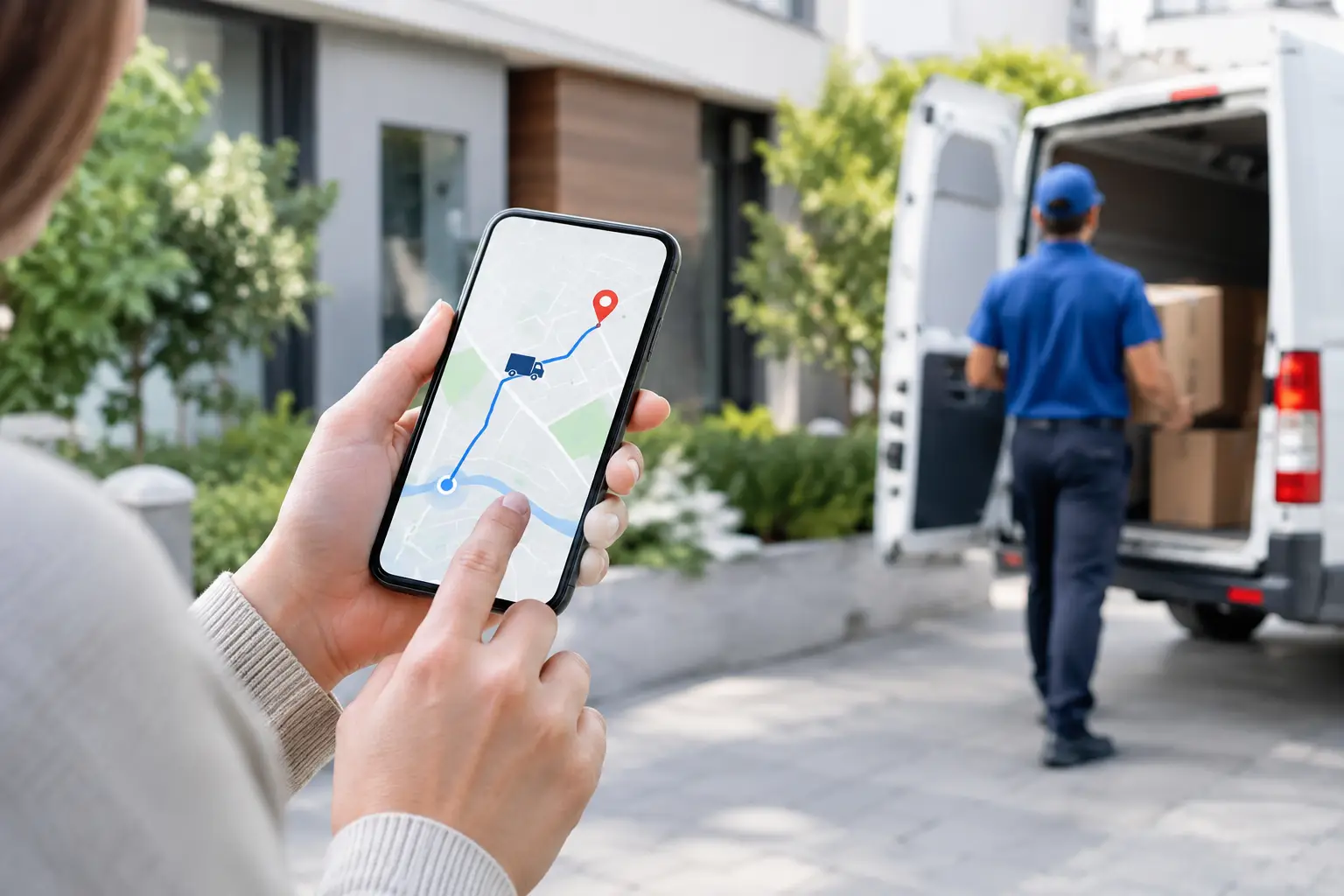
A print run needed for a morning launch, a replacement machine part holding up a production line, or a fragile display unit due at a shop fitting site cannot simply disappear into a depot network. Real time courier tracking gives the sender a clear view of what is happening from collection to delivery, so they can protect the job, update their customer and act quickly if plans need to change.
For urgent or high-value consignments, tracking is not a nice extra. It is part of proper delivery control. The difference is especially clear when a consignment travels in a dedicated vehicle rather than through a multi-drop parcel network.
What real time courier tracking should tell you
A useful tracking service does more than show a vehicle moving across a map. It should give you timely, meaningful information: confirmation that the driver has collected the goods, the vehicle’s live location, progress towards the delivery address and confirmation when the consignment has been handed over.
That visibility matters because it replaces assumptions with facts. If a site manager asks whether a component will arrive before a scheduled installation, you can give an informed answer. If a recipient needs to arrange access, loading support or a named person to receive the goods, they can prepare at the right time.
The most valuable updates are those tied to real operational stages. A vehicle icon on a screen has limited value if nobody knows whether the consignment is safely loaded, whether the driver is travelling directly to the destination, or whether a delivery has been completed. Good tracking supports those answers with clear status updates and proof of delivery.
Why tracking matters more for dedicated deliveries
Standard parcel services are built to move high volumes efficiently. That works well for routine boxed items with flexible delivery expectations. It is less suitable for an urgent legal document, a one-off fabricated part, an exhibition stand, a delicate artwork or equipment that must arrive at a precise time.
In a conventional network, an item may pass through several hands, vehicles and depots before reaching its destination. Each transfer introduces another point at which it can be delayed, misrouted or damaged. Tracking may show scans at different hubs, but it cannot remove the underlying uncertainty created by multiple handling stages.
A dedicated same-day courier model is different. One vehicle collects one important consignment and takes it directly to its UK destination. There are no unrelated multi-drop collections, no depot transfers and no avoidable unloading and reloading. Real time courier tracking then reflects a straightforward journey that is easier to monitor and easier to manage.
That direct control is particularly useful when the delivery is commercially critical. A delayed pallet of materials can leave a construction team waiting. A missed timed delivery can disrupt a retail launch. A damaged item can mean an expensive reprint, replacement or lost trading day. Knowing where the consignment is helps, but knowing it is travelling under controlled conditions is what provides real reassurance.
Tracking supports better decisions, not just better updates
Operational teams often need to coordinate several people around a delivery. A delivery may require a goods-in booking, security clearance, a forklift, a site contact or a customer representative to be present. Accurate location information helps everyone work to the same plan.
It also allows for practical intervention when circumstances change. Road closures, serious congestion and restricted site access can affect even the best-planned journey. With live oversight, a transport team can assess the issue, communicate honestly and make an informed decision. That may mean advising the recipient of a revised arrival time, arranging an alternative delivery point, or confirming that the driver remains on course despite a delay shown on public traffic reports.
The key is communication. Automated notifications are helpful, but they should not replace access to people who understand the load and the delivery requirement. For complex consignments, customers need a transport provider that can explain what is happening in plain terms and take ownership of the next step.
The handling behind the tracking screen
A tracking system can only report a journey. It cannot make an unsuitable vehicle safe, secure an awkward load or protect fragile goods from poor handling. That is why the transport arrangement behind the tracking matters just as much as the technology.
Before collection, the consignment should be assessed properly. Its dimensions, weight, value, fragility, urgency and unloading requirements all affect the vehicle and equipment needed. A small van may be right for urgent documents or compact packages. A larger van, curtain-sided vehicle or 26-tonne lorry may be needed for machinery, oversized materials or multiple items. Some loads also need specialist features such as a sliding roof or mounted forklift.
Matching the vehicle to the job helps prevent the avoidable problems that tracking cannot solve. An oversized item squeezed into the wrong vehicle may be at risk before the driver has left the collection point. A site without unloading equipment may require a vehicle with its own lifting capability. A time-sensitive collection from central London may need planning around access restrictions and ULEZ requirements.
The driver is equally important. Trained drivers who understand careful loading, restraint and delivery procedures are the people protecting the consignment between each tracking update. Technology provides visibility; professional handling provides confidence that there is something worth tracking.
What to look for when choosing a tracked courier
Not every tracked service offers the same level of control. When a delivery matters, ask what happens after collection as well as what appears on the tracking page.
First, establish whether the vehicle is dedicated to your consignment. A direct journey is usually the right choice for urgent, valuable, fragile or unusually shaped goods. It reduces handling and makes estimated arrival times more dependable.
Next, ask how collection and delivery are confirmed. A proper service should be able to provide clear collection confirmation and proof that the consignment has reached the agreed recipient. For sensitive goods, it is sensible to confirm whether delivery can be made only to a named contact or during a specific time window.
You should also ask who will deal with a problem. If a delivery needs attention, you want a transport contact who can see the job, speak to the driver and give a direct answer. A generic customer service queue is rarely enough when a production line, event or site programme is waiting.
Finally, be open about the consignment. Accurate dimensions, weights, collection restrictions and destination details allow the courier to plan correctly from the outset. It may feel quicker to provide only basic information, but missing details often cause the delays customers are trying to avoid.
When live tracking is not enough on its own
There are occasions when tracking needs to be paired with a more hands-on service. A high-value item may require enhanced security procedures. A fragile load may need specialist packaging advice and careful securing. An oversized delivery may need a route assessment, a timed site slot or lifting equipment at one or both ends.
For those jobs, the right question is not simply, “Can I track it?” It is, “Can this courier take responsibility for the whole move?” The strongest answer combines direct transport, suitable equipment, trained drivers and clear updates throughout.
Redhead Couriers provides that practical control for businesses and private customers whose deliveries cannot be treated like ordinary parcels. The focus is simple: the right vehicle, careful handling, a direct journey and visible progress from collection through to completion.
When the consignment is important, treat tracking as part of the delivery plan rather than an afterthought. Give your courier the full brief, agree what successful delivery looks like and make sure the people waiting at the destination have the information they need. That is how a tracked journey becomes a delivery you can rely on.